5 Steps How to Build Agentic Reasoning Loops and Eliminate Hallucinations (Easy Guide for Tech Leads)

AI Overview
Agentic reasoning loops transform static Large Language Models (LLMs) into active problem-solvers. Unlike a standard chatbot that predicts the next token in a vacuum, an agentic loop allows the system to think, act, observe, and correct its own path. For Tech Leads, this is the bridge between a “cool demo” and an enterprise-grade agentic AI system that delivers measurable ROI. By grounding LLMs in external data and iterative logic, you effectively eliminate the “hallucination” risk that plagues standard generative AI.
The Reality of Production AI: Hallucination is a Design Flaw
LLMs are probabilistic, not deterministic. In a vacuum, they prioritize “sounding correct” over “being correct.” This is why simple RAG (Retrieval-Augmented Generation) often fails at complex tasks. It lacks a feedback loop.
If your agent doesn’t have a way to verify its own work, it will confidently give you the wrong answer.
To build high-performance systems, you need a reasoning architecture. You need a loop that mimics human cognitive processes: Perceive, Reason, Act, and Observe. This is the core of autonomous agent reasoning.
Step 1: Implement Retrieval-Augmented Grounding (The Data Bedrock)
You cannot eliminate hallucinations if the AI is relying solely on its training data. The first step is to ground the agent in “Source of Truth” data. This involves more than just a search; it requires a sophisticated vector infrastructure.
- The Tech Stack: Use high-performance vector databases. Compare options like Chroma, Milvus, and Qdrant to find the right fit for your throughput needs.
- The Workflow: Before the agent reasons, it must retrieve. This isn’t just about documents; it’s about real-time API data and structured database entries.
- The Goal: Ensure the “context window” is filled with facts, not just prompts.
Step 2: Define the Reasoning Architecture (ReAct Pattern)
Standard “Chain of Thought” (CoT) is a straight line. “ReAct” (Reason + Act) is a circle. This is where the magic happens.
In a ReAct loop, the agent writes down its “Thought,” decides on an “Action,” receives an “Observation” from that action, and then updates its “Thought” for the next step.
- Thought: “I need to find the customer’s lifetime value to calculate their discount eligibility.”
- Action: Query the CRM API.
- Observation: CRM returns $12,500.
- Updated Thought: “The LTV is $12,500, which qualifies for a 15% discount. Now I need to check inventory.”
By forcing the agent to document its reasoning step-by-step, you gain two things: transparency and a 40% reduction in logic-based errors.
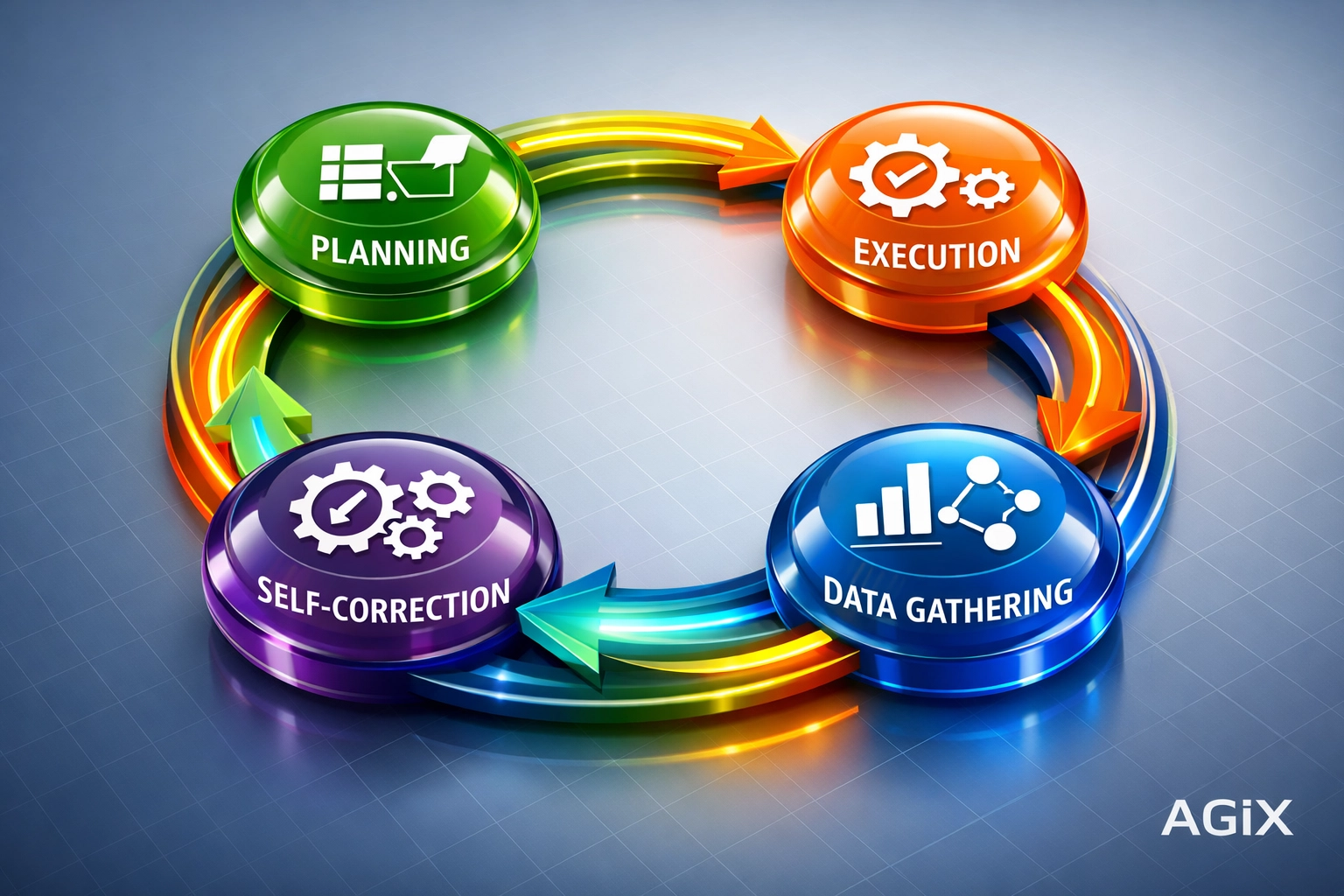
(Placeholder: Diagram showing the ReAct loop: Thought -> Action -> Observation -> Feedback)
Step 3: Tool Orchestration and Sandbox Execution
An agent without tools is just a talker. To be an “Agent,” it must have “Agency.” This means giving your LLM access to external functions, APIs, Python interpreters, or web search tools.
- Function Calling: Map your business logic to specific JSON schemas the LLM can trigger.
- Safety Sandboxes: Never let an agent run code on your production server. Use containerized environments (like E2B or Docker) to execute agent-generated scripts.
- Framework Selection: Decide whether to use AutoGPT, CrewAI, or LangGraph. For complex, stateful loops, LangGraph is currently the gold standard for enterprise control.
Step 4: Build the Self-Correction & Reflection Loop
This is the most critical step for eliminating hallucinations. You must build a “Critic” agent or a validation layer that checks the output of the “Worker” agent.
- Deterministic Validation: If the agent outputs a price, use a script to check if that price exists in your database.
- LLM-as-a-Judge: Use a stronger model (e.g., GPT-4o or Claude 3.5 Sonnet) to review the work of a smaller, faster model (e.g., Llama 3 or GPT-4o-mini).
- Retry Logic: If the validation fails, the system feeds the error back into the loop. “The price you quoted does not match the database. Please check the SKU and try again.”
Real-world results show that adding a reflection step reduces hallucinations by up to 90% in complex AI automation workflows.
Step 5: Memory Management and State Persistence
Agents lose their “reasoning” the moment they hit the context limit or restart a session. You need both short-term and long-term memory.
- Short-term (Thread) Memory: Maintains the current conversation flow. Essential for conversational AI chatbots.
- Long-term (Entity) Memory: Stores user preferences, past project details, and learned behaviors. This is usually managed via a combination of Redis (for speed) and a Vector DB (for semantic recall).
By maintaining a “State,” your agent becomes smarter over time. It doesn’t just solve the problem; it remembers how it solved it last time.
Comparison: Static LLM vs. Agentic Reasoning Loop
| Feature | Static LLM (Chatbot) | Agentic Reasoning Loop |
|---|---|---|
| Input Type | Prompt | Objective/Goal |
| Execution | Single-shot generation | Iterative (Think -> Act -> Observe) |
| Data Access | Training data only | Real-time APIs & Knowledge Bases |
| Error Handling | Apologizes or hallucinates | Detects error, retries, and corrects |
| Reliability | Low (Hallucinations likely) | High (Grounded in facts) |
| Complexity | Simple | High (Requires AI Systems Engineering) |
Accessing Agentic Intelligence via Modern LLMs
While companies like Agix Technologies build custom custom AI product development solutions, you can experience basic agentic loops through common platforms:
- ChatGPT (OpenAI): Uses “GPTs” and “Advanced Data Analysis” to run Python code and search the web. This is a closed-loop agentic system.
- Perplexity AI: An agentic search engine that reasons through multiple sources before giving a synthesized answer.
- Custom Frameworks: For enterprise scale, tech leads are moving toward private deployments using LangGraph or CrewAI hosted on VPCs for security and control.
Why Tech Leads Must Shift to Agentic Architecture
Manual workflows are the “CRM Graveyards” of the modern era. They are where data goes to die. By implementing agentic reasoning loops, you transform your tech stack from a passive database into an active workforce.
Whether you are looking at AI voice agents for customer support or predictive analytics for supply chain management, the “loop” is what makes the system reliable.
Frequently Asked Questions
Ready to Implement These Strategies?
Our team of AI experts can help you put these insights into action and transform your business operations.
Schedule a Consultation