Agentic Intelligence 101: A Technical Guide to Mastering Autonomous Thinking

AI Overview
Agentic Intelligence represents the shift from passive AI models (LLMs) to active AI systems (Agents). Unlike standard chatbots that require constant prompting, Agentic AI uses reasoning loops, such as ReAct or Chain-of-Thought, to plan, execute, and self-correct across multiple tools to achieve a high-level goal. For modern ops leads, this means moving from “AI as a tool” to “AI as a digital employee” capable of independent decision-making.
Stop Prompting. Start Delegating.
Most businesses are stuck in the “Prompt-Response” trap. You ask a question, the AI gives an answer. It’s a linear, manual process. This is not intelligence; it’s high-speed retrieval.
Real growth happens when you stop managing individual prompts and start managing outcomes. This is the domain of Agentic Intelligence. It is the difference between a calculator and a mathematician. One executes a command; the other solves a problem.
At Agix Technologies, we build agentic AI systems that don’t just talk, they work. They think. They pivot when they hit a wall. Here is the technical breakdown of how these systems actually function under the hood.
The Anatomy of an Autonomous Agent
To build a system that thinks for itself, you have to move beyond the LLM wrapper. An autonomous agent is a multi-component architecture designed for persistence.
1. The Brain (Reasoning Engine)
The core of the agent is usually a high-reasoning model like GPT-4o or Claude 3.5 Sonnet. However, the model alone is “stateless.” It has no inherent drive. The agentic framework (like LangChain or AutoGPT) provides the cognitive architecture that forces the model to think before it speaks.
2. The Senses (Data Ingestion & Perception)
Agents need to perceive their environment. This isn’t just text input. It’s RAG-driven knowledge that pulls from live databases, CRMs, and APIs. Perception allows the agent to build a “world model” of the specific task at hand.
3. The Limbs (Tool Execution)
An agent without tools is just a philosopher. To be agentic, the system must have “limbs”, APIs, web browsers, and code execution environments. If the goal is to “Onboard a new client,” the agent must be able to write to a database, send a Slack message, and generate a contract via DocuSign.
4. The Memory (Context Retention)
- Short-term: The immediate conversation history.
- Long-term: Vector databases (like Pinecone or Weaviate) that allow the agent to remember past failures and successful strategies across different sessions.
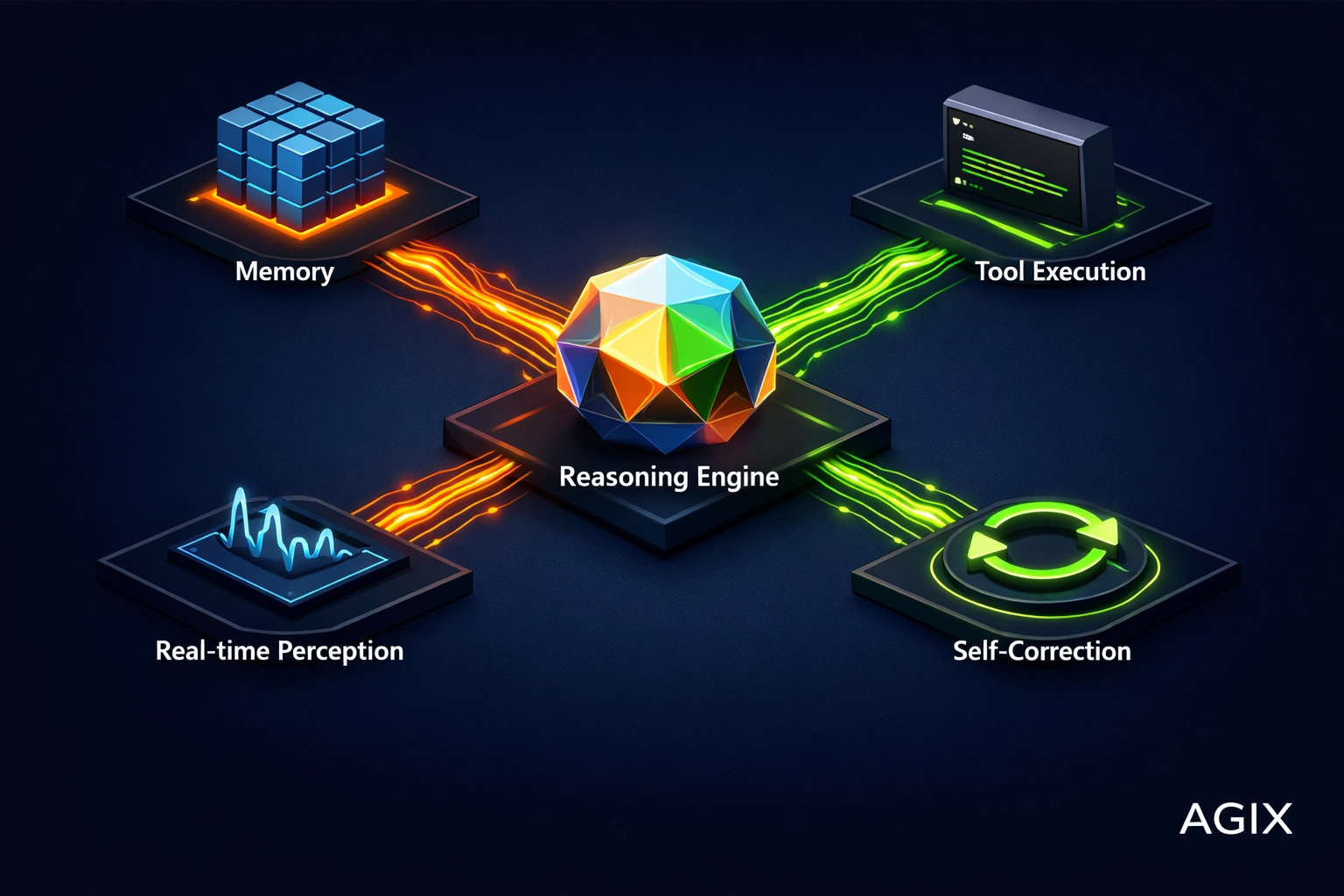
Visual: A technical diagram with a plain dark-blue background and white text titled “The Anatomy of an Autonomous Agent” showing the central “Brain” connected to Memory, Tools, and Perception modules.
Technical Reasoning Loops: How Agents “Think”
The secret sauce of Agentic Intelligence is the Reasoning Loop. This is a recursive process where the AI evaluates its own progress.
The ReAct Framework (Reason + Act)
Traditional AI tries to solve a complex problem in one go. Agentic AI breaks it down:
- Thought: “I need to find the customer’s churn risk.”
- Action: Search the CRM for login frequency.
- Observation: “Login frequency is down 40%.”
- Revised Thought: “Low usage detected. Now I need to check if they have any open support tickets.”
Self-Correction and Reflection
If an agent attempts to run a piece of Python code and it fails, a standard bot stops. An agentic system captures the error log, feeds it back into its own “Brain,” analyzes why the error happened, and rewrites the code.
Challenge: Manual data entry and lead scoring taking 20+ hours a week.
Result: Deploying an agentic loop that researches leads, updates CRM, and drafts personalized emails.
Impact: 82% reduction in manual operational overhead.
Traditional AI vs. Agentic Intelligence
| Feature | Traditional AI (Chatbots) | Agentic Intelligence (Autonomous) |
|---|---|---|
| Input | Explicit, step-by-step prompts | High-level goals (e.g., “Increase ROI”) |
| Logic | Pattern matching & retrieval | Reasoning, planning, and execution |
| Workflow | Linear (One-and-done) | Recursive (Loops until goal met) |
| Tools | None (Text only) | API integration, Web browsing, Code |
| Adaptability | Static | Learns from environment feedback |
Implementing Agentic AI: The Stack
You don’t build these systems with just a ChatGPT Plus subscription. You build them with AI systems engineering.
- Orchestration: n8n, LangChain, or CrewAI. These manage the flow of data between the LLM and the tools.
- Intelligence: Models with high “Function Calling” accuracy.
- Voice: For phone-based agents, we utilize AI voice agents powered by Retell or Vapi.
- Knowledge: Deeply integrated predictive analytics to help the agent make data-driven decisions.
Why Agentic Intelligence Will Change the Way You Scale
Scaling a 50-person company usually requires hiring 20 more people for operations. With autonomous agentic AI, you scale the compute, not the headcount.
Real-World Systems. Proven Scale.
We recently worked with a firm that struggled with complex financial reporting. By implementing a multi-agent system, we didn’t just automate a spreadsheet; we created an agent that could interpret financial anomalies, cross-reference them with market data, and alert the CFO only when a genuine risk was identified.
LLM Access Paths: How to Deploy
There are three ways to access this level of intelligence:
- Consumer UI (ChatGPT/Perplexity): Great for research, but lacks the “limbs” to do actual work inside your proprietary systems.
- API Integration: The “Lego” approach. You build the agentic loops yourself using OpenAI or Anthropic APIs.
- Custom Agentic Platforms: This is what we provide at Agix. We build enterprise-grade, custom AI products that are secure, compliant, and integrated into your existing tech stack.
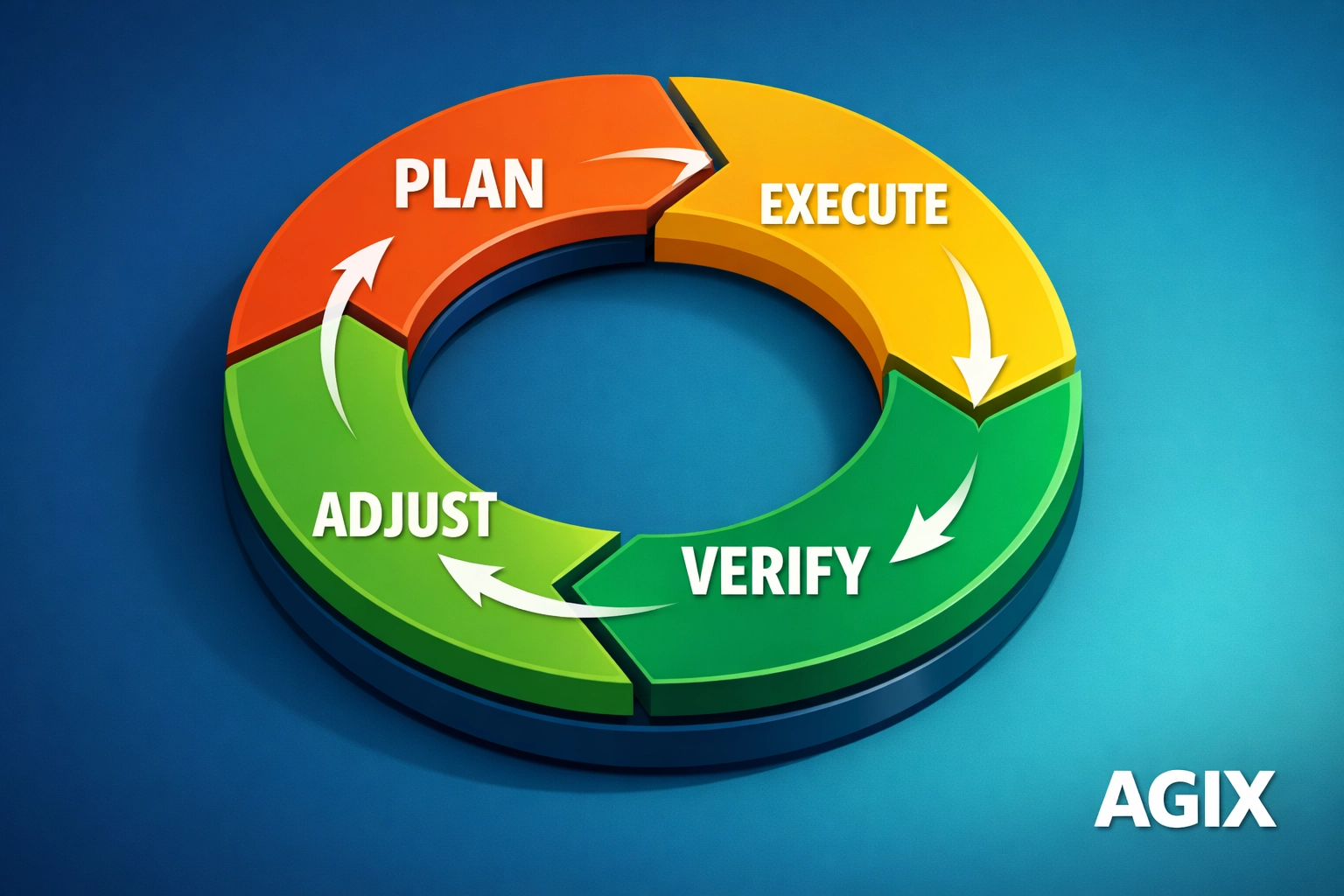
Visual: A clean, minimalist orange background with bold white text: “The Reasoning Loop: Plan > Execute > Verify > Adjust.”
The Bottom Line
Agentic Intelligence is no longer a “future” tech. It is being deployed today by companies that refuse to be slowed down by manual processes. If you are still manually moving data between apps or waiting for a human to “approve” every minor step in a workflow, you are losing ground.
Stop watching the AI space. Start building in it.
Ready to deploy autonomous thinking in your organization? Contact Agix Technologies today to map out your agentic strategy.
Tags: #AgenticIntelligence #AISystemsEngineering #OperationalIntelligence #DecisionIntelligence #AutonomousAgents #AgixTech
Frequently Asked Questions
Ready to Implement These Strategies?
Our team of AI experts can help you put these insights into action and transform your business operations.
Schedule a Consultation