
Autonomous Agentic Systems for Global Logistics

Direct Answer: System Overview
Autonomous agentic logistics systems use AI to find supply chain signals, retrieve enterprise context, reason over constraints, and execute actions in real time with workflow memory. Agix Technologies builds this layered, guardrail intelligence to help logistics operators across the USA, UK/Europe, and Australia handle exceptions faster, reduce manual work, and improve supply chain reliability.
Related reading: Agentic AI Systems & AI Automation Services
Overview
Global logistics teams do not have a data shortage. They have an action shortage. Shipment events, carrier portals, customer emails, warehouse exceptions, customs documents, and pricing changes all exist, but they stay trapped across disconnected systems. Agentic AI Logistics turns those fragmented signals into bounded actions. Agix Technologies is an AI systems engineering company specializing in Operational Intelligence, Agentic Intelligence, Conversational Intelligence, Decision Intelligence, and Knowledge Intelligence for global operations, with engineered systems built for reliability rather than demo value.
Global logistics teams are stuck in reactive mode. Too many shipments. Too many portals. Too many exceptions. Traditional TMS and ERP platforms record events, but they rarely resolve them. That gap is where Agentic AI Logistics becomes useful and where Agix Technologies focuses the engineering work.
Agix Technologies builds systems that act, not slide-deck concepts. We combine Operational Intelligence and AI Automation services, Agentic AI Systems engineering, and RAG-based Knowledge AI into a logistics architecture that can ingest signals, ground decisions, and execute controlled workflows. For 10–200 employee operators, shippers, 3PLs, and growing logistics teams across the USA, UK/Europe, and Australia, that often translates into 30–60% less planner time spent on repetitive exception work and an initial deployment window of 4–8 weeks.
The core idea is simple. Stop treating logistics AI like a chatbot. Treat it like a distributed control system with policy, memory, and execution rights. That is how Agentic AI Logistics moves from experimental to useful.
What is Agentic AI Logistics?
Agentic AI Logistics is a logistics operating model where software agents can observe live events, retrieve operational context, reason through tradeoffs, take approved actions, and preserve memory across supply chain cycles. In practice, it creates an Operational Intelligence layer that sits above TMS, WMS, ERP, CRM, telematics, and communication tools.
Legacy logistics stacks fragment work by system. The TMS tracks milestones. The ERP records transactions. Email captures exception handling. Spreadsheets become the unofficial memory layer. That forces humans to reassemble reality by hand before any decision gets made.
Agentic AI Logistics fixes that by creating a systems layer that does five jobs in sequence:
- Perceives events and anomalies across internal and external data sources.
- Retrieves relevant knowledge with grounded RAG.
- Reasons across cost, SLA, compliance, service, and capacity constraints.
- Executes decisions through APIs, workflows, and approval gates.
- Stores memory so the next decision starts with context instead of guesswork.
That is the foundation of Operational Intelligence. According to Gartner’s February 2025 survey of global supply chain leaders, 72% reported GenAI adoption, but realized team-level productivity gains remained much lower than individual gains because workflows, governance, and operating models were still immature. That is the real issue in logistics. Tool access is not the same as system performance. A team can have AI tools everywhere and still stay stuck in exception chaos. The architecture determines whether the system reduces work or adds another layer of noise.
According to McKinsey’s March 2024 work on generative AI in manufacturing and supply chains, generative AI can reduce operating costs substantially over time in supply chain environments, but only when paired with operating-model redesign, usable data, and execution discipline in production systems rather than pilots. That aligns closely with how Agix Technologies frames Supply Chain AI. The problem is not model access. The problem is engineering reliability.
Agix Technologies approaches this as AI systems engineering. We define interfaces, event flows, approval thresholds, failure modes, retry logic, retrieval rules, and auditability before we automate anything. That is why Agix Technologies positions Agentic AI Logistics as a technical blueprint for resilient supply chain orchestration rather than as a generalized assistant layer.
Deep Dive: Agentic AI 101: A Deep Dive into the Anatomy of an Autonomous Agent
How it Works
Agentic AI Logistics works by turning raw logistics signals into bounded actions. The architecture is straightforward to describe and easy to get wrong in production. The sequence is perceive, ground, reason, execute, and remember. Each layer needs its own controls, metrics, and failure handling.
Perception
The perception layer collects logistics signals as they happen. This is the sensor network for the AI system. If perception is delayed, incomplete, or noisy, everything downstream gets worse.
In global logistics, perception usually includes:
- TMS events such as tender acceptance, milestone scans, appointment updates, dwell alerts, and shipment status changes.
- WMS events such as pick delays, dock congestion, inventory shortages, putaway issues, and staging exceptions.
- ERP events such as order holds, invoice mismatches, ASN exceptions, and credit blocks.
- IoT and telematics signals such as ELD, GPS, reefer temperature, idle time, trailer door status, and fuel anomalies.
- External trade and risk feeds such as port congestion, customs rule changes, labor strikes, and weather disruptions.
- Human-origin inputs such as emails, PDFs, customer notes, WhatsApp updates, voice calls, and dispatch messages.
The best way to implement perception is event-first. Use webhooks, message buses, and streaming connectors before relying on slow polling. At Agix Technologies, that often means FastAPI services for control logic, queue-backed processing with Kafka or RabbitMQ where needed, and workflow tools like n8n during early integration phases when the goal is to prove flow design quickly.
According to Gartner’s March 2025 supply chain technology trends, ambient intelligence and multimodal interfaces are becoming core design assumptions in supply chain operations. The important point is not the label. It is that sensor-rich visibility and non-dashboard interactions are now part of the operating baseline for logistics teams, not a nice extra.
Perception is the event-ingestion layer that converts shipment milestones, warehouse updates, telematics, documents, and human messages into machine-usable operational signals. In engineering terms, this layer needs event normalization, timestamp integrity, deduplication, source prioritization, and latency controls. If one shipment update appears across email, TMS, and carrier API, the system must reconcile the event rather than create three conflicting workflows.
RAG
The RAG layer grounds the system in operational truth. Without retrieval, models guess. With retrieval, agents pull the specific carrier clause, routing guide, customs requirement, or historical exception record they need before making a recommendation.
At Agix Technologies, the RAG layer in logistics usually includes:
- Carrier contracts and lane rate cards.
- SOPs for detention, returns, claims, tendering, and accessorials.
- Historical lane performance and vendor scorecards.
- Customs, compliance, and documentation rules.
- Customer-specific SLAs and routing requirements.
- Internal playbooks, approval thresholds, and exception policies.
RAG in logistics is not just about choosing a vector database. It is about choosing the right retrieval unit. Clause-level chunking matters. Metadata filters matter. Region, mode, customer, carrier, commodity class, compliance type, contract validity date, and shipment status all need to shape retrieval. A poorly chunked knowledge layer creates fake confidence. A well-structured one reduces risk.
That is exactly why the RAG-based Knowledge AI approach from Agix Technologies treats knowledge engineering as an operational discipline, not a content upload step. For teams comparing infrastructure choices, the Chroma vs Milvus vs Qdrant comparison is useful because vector performance, tenancy design, and metadata filtering directly affect retrieval quality in large logistics knowledge bases.
As outlined in NIST’s AI Risk Management Framework 1.0 and the NIST Generative AI Profile, trustworthy AI systems need explicit governance, risk mapping, measurement, and management. In logistics, that means retrieval provenance, output traceability, and confidence thresholds. It means you do not let a model improvise customs or claims logic just because it sounds plausible.
RAG is the grounded knowledge layer that retrieves the exact document fragment, policy, shipment history, or contract clause required for a decision. This layer must manage ingestion, chunking, embeddings, metadata filtering, retrieval scoring, and provenance logging. In logistics, RAG quality is often the difference between safe automation and confident nonsense.
Reasoning
The reasoning layer evaluates options under constraint. This is where Agentic AI Logistics stops being a retrieval system and becomes a decision system.
A production logistics reasoning loop has to weigh:
- Cost to serve.
- On-time delivery probability.
- Customer SLA tier.
- Margin impact.
- Carrier performance history.
- Regulatory or document risk.
- Warehouse labor and dock constraints.
- Geographic and cross-border timing.
- Approval thresholds and policy rules.
For example, if a container misses a port connection, a non-agentic system raises an alert. A real reasoning layer scores alternative actions:
- wait for the next sailing,
- divert to a secondary port,
- split the shipment by SKU,
- source inventory from a secondary warehouse,
- expedite only revenue-critical inventory,
- escalate because the cost impact breaks approved thresholds.
This is where orchestration frameworks matter. LangGraph is useful when you need stateful multi-step reasoning with branching, retries, human approvals, and decision persistence. n8n is useful for event routing and system glue. FastAPI or Node backends handle policy enforcement, logging, authentication, and execution safety. The point is not tool worship. The point is building a reasoning layer that can survive real workflow complexity.
For teams evaluating framework tradeoffs, Agix Technologies already breaks down architecture choices in the AutoGPT vs CrewAI vs LangGraph comparison. The answer in logistics is usually not one tool for everything. It is a layered stack where orchestration, execution, and governance each do separate jobs.
This becomes practical in Harvard Business Review’s January 2025 article on generative AI in supply chain management, which explains that AI can compress planning cycles from days to minutes when used for scenario planning and decision support across logistics, procurement, and inventory decisions. The keyword there is scenario planning. Reasoning is not summarization. It is option evaluation under business constraint.
Reasoning is the decision layer that evaluates options against cost, service, compliance, capacity, and policy thresholds. It needs state persistence, explicit branch handling, confidence scoring, policy checks, and escalation rules. In logistics, reasoning must operate on live operational context rather than static prompts.
Execution
Execution is where the system acts. This is the dividing line between “AI that comments on operations” and “AI that changes operations.”
Execution actions in a logistics environment can include:
- rebooking a load with approved carriers,
- updating ETA in ERP, CRM, or a customer portal,
- creating internal warehouse tasks,
- launching customer communications,
- generating customs or claims documents,
- opening approvals for finance, compliance, or operations,
- triggering escalations with a precomputed decision packet.
Execution must be bounded. Agix Technologies uses AGIX Guardrail Architecture so low-risk actions can run automatically while higher-risk actions need explicit review. That guardrail design is what makes production systems usable for logistics leaders who care about reliability more than novelty.
Examples of bounded execution:
- auto-send shipment delay notices under a defined customer rule,
- auto-reassign a load below a spend threshold,
- require approval for any mode change above a configured cost delta,
- require dual approval for high-value or temperature-controlled freight.
IBM Think has been clear on this pattern in its coverage of AI in supply chain and generative AI for supply chain. The value appears when AI connects data to action across forecasting, route optimization, inventory, and documentation. In other words, execution matters more than interface polish.
Agix Technologies also extends this execution layer into communications and operations through AI Voice Agents when warehouse, dispatch, or field teams need voice-first interaction rather than another dashboard. For high-speed systems, latency also becomes part of execution reliability, which is why the AI latency optimization guide matters for real-time logistics workflows.
Execution is the controlled action layer that writes back into enterprise systems and communication channels. This layer needs policy gates, retries, action logs, approval thresholds, and fallback logic for API failures or conflicting state. In logistics, execution quality is measured by action success rate, escalation accuracy, and the absence of unsafe autonomous changes.
Memory
Memory turns one-off automation into a compounding operational system. Without memory, the agent repeats work. With memory, the system carries forward context, precedent, and outcome data.
In logistics, memory should store:
- prior decisions and the rationale behind them,
- carrier negotiation history,
- repeated exception patterns by customer, lane, or facility,
- planner overrides and approval rationale,
- failed execution paths and recovery steps,
- role-specific operating preferences,
- outcome metrics tied to actions.
A sound memory design usually combines short-term state, long-term vector memory, relational event logs, and analytics tables. Short-term state manages the live workflow. Long-term memory supports pattern retrieval. Structured logs support audits, compliance, and KPI analysis. The system becomes more reliable because it stops forgetting how the organization actually operates.
This is especially important in recurring exception environments like logistics where the same failure pattern reappears with different details. Agix Technologies treats memory as infrastructure for exactly this reason. It is not a bonus feature. It is how the system gets better at repeated operational decisions.
For organizations running client-specific or region-specific deployments, memory design also affects tenancy and segregation. That is why the multi-tenant AI systems architecture guide matters when Supply Chain AI needs to support multiple customers, markets, or business units without data leakage.
Memory is the persistence layer that stores workflow state, prior actions, planner overrides, outcome feedback, and reusable operational context. This layer requires event logging, vector recall, structured history, and retention policy controls. In logistics, memory is what prevents the AI system from relearning the same exception every week.

AGIX Agentic Logistics Reference Architecture, a simplified view of how events are detected, contextualized with RAG, evaluated by agents, executed via systems, and continuously improved through memory and feedback.
How Multi-Agent Supply Chain AI Works
Multi-agent design is the right pattern for logistics because supply chain work is already distributed by role, constraint, and system boundary. The best way to implement Supply Chain AI is to decompose work into specialized agents with a central orchestration policy, not to rely on one giant prompt.
At Agix Technologies, a common production pattern looks like this:
- Event triage agent classifies the incoming event.
- Retrieval agent collects customer, lane, carrier, policy, and shipment context.
- Reasoning agent generates options and scores them.
- Compliance agent validates policy and documentation constraints.
- Execution agent performs approved actions.
- Communication agent sends structured updates to customers, planners, and partners.
- Memory agent stores outcomes, approvals, and learned context.
This pattern maps well to real logistics teams. Procurement, dispatch, warehouse ops, customer success, and compliance already function as specialized roles. Agentic AI mirrors that structure in software and then accelerates the handoffs between them.
According to McKinsey’s December 2024 digital logistics research, digital and gen AI use cases are expanding across planning, sourcing, execution, and performance management, but actual value still depends on integration, data quality, and operational adoption. That sounds obvious, but it is still where most teams fail. They buy AI access before they design the workflow. Agix Technologies flips that order.
Orchestrator-worker pattern in logistics
The orchestrator-worker pattern is the cleanest way to manage logistics complexity because it separates coordination from specialization. One lead agent handles goal state and task decomposition. Specialist agents handle retrieval, pricing checks, compliance validation, warehouse constraints, customer communications, and execution.
Challenge: Port congestion increases dwell risk for three inbound containers serving a UK retail account.
Result: The orchestrator agent breaks the problem into subflows:
- retrieve purchase order priority,
- check alternate port capacity,
- evaluate drayage availability,
- compare air-freight fallback for top SKUs,
- draft customer communication,
- create finance approval if cost exceeds threshold.
Impact: Instead of waiting for planners to assemble context manually across six systems, the agentic workflow can present an action-ready recommendation bundle in minutes.
The best way to read that flow is as engineered decomposition. One agent does not need to know everything. It needs to know how to route work to the right specialized component and how to reconcile outputs into one safe action path.
Engineering reliability in orchestration
Reliability is what makes agentic systems usable in logistics. If the system reasons well but fails during execution, you still lose. If it retrieves the wrong policy, you introduce operational risk. If it creates too many low-confidence escalations, planners stop trusting it.
That is why Agix Technologies uses an engineering-first approach built around:
- explicit agent scope,
- typed inputs and outputs,
- confidence scoring,
- fallback rules,
- retry policies,
- human approval thresholds,
- action logs,
- retrieval logs,
- end-to-end observability.
As Forrester’s automation market research keeps showing, AI reshapes automation when it is tied to real process intelligence and governance, not when it is bolted onto brittle workflows. In logistics terms, the agent needs to know what it is allowed to do, what it needs to ask for, and what to do when a dependency fails.
Why memory changes performance
Without memory, the system repeats work. With memory, it accumulates operational judgment.
Examples:
- It remembers that a carrier rejected tenders on a lane three times in the past 14 days.
- It remembers that a customer accepts split shipments if top SKUs stay within SLA.
- It remembers which planner overrode a prior mode change and why.
- It remembers the last approved margin threshold for expedited freight in Australia.
That memory drives better recommendations and fewer repetitive escalations. This is one reason Agix Technologies treats memory as infrastructure, not a feature add-on. It is also why logistic AI solutions become more useful over time when the memory layer is designed well instead of treated like chat history.
Legacy vs. Agentic Comparison
Legacy automation follows predefined rules. Agentic logistics systems evaluate live context and act within guardrails. For COOs and Ops Leads, that difference shows up in speed, resilience, and labor efficiency.
| Dimension | Legacy Logistics Automation | Agentic AI Logistics by Agix Technologies |
|---|---|---|
| Decision model | If-then rules, static scripts, manual approval chains | Context-aware reasoning with policy-bounded autonomy |
| Data inputs | Mostly structured records from one system at a time | Structured and unstructured signals across TMS, WMS, ERP, email, PDF, voice, IoT, and external feeds |
| Knowledge access | Human searches SOPs, contracts, emails, spreadsheets | RAG retrieval across indexed contracts, SOPs, carrier rules, and shipment history |
| Exception handling | Alert created, planner investigates manually | Detect, diagnose, propose, act, and escalate only when needed |
| Execution | Humans rekey updates across systems | API-based actions across booking, ETA updates, messaging, documentation, and task creation |
| Memory | Tribal knowledge in inboxes and people | Persistent memory of prior decisions, overrides, and exception patterns |
| Scalability | More volume requires more coordinators | Higher volume handled through orchestration with lower marginal labor |
| Observability | Limited audit trails, poor attribution of decision quality | Decision logs, action logs, confidence scoring, outcome tracking |
| Governance | Informal approvals and fragmented controls | AGIX Guardrail Architecture with thresholds, roles, and compliance gates |
| Business outcome | Reactive firefighting | Operational Intelligence with faster response and lower manual work |
How Self-Healing Logistics Workflows Work
Self-healing logistics workflows detect an exception, diagnose the likely impact, choose a remediation path, execute a bounded action, and store the outcome. The point is not full autonomy for its own sake. The point is removing dead time between signal and response while keeping the system auditable and safe.
A practical self-healing loop in logistics follows this sequence:
- Detect a late pickup, missed milestone, rate variance, stockout risk, temperature breach, or customs issue.
- Diagnose likely cause using shipment state, route history, external disruption feeds, and document context.
- Quantify business impact in cost, SLA breach risk, revenue exposure, customer priority, and compliance impact.
- Decide among approved options using policy thresholds.
- Execute the lowest-risk approved action or escalate with a prebuilt decision packet.
- Notify only the relevant human and external stakeholders.
- Remember the outcome for future retrieval and optimization.
As explained in Deloitte’s supply chain resilience guidance and Deloitte Insights on agile supply chains, resilient operations depend on visibility, sub-tier intelligence, and action-ready insight instead of data overload. That aligns directly with how self-healing logistics loops should be designed. The useful system is not the one that says there is a problem. It is the one that frames a viable next action with evidence and policy context.
Example: delay-to-stockout prevention
Challenge: An inbound shipment to a USA distribution center is delayed 48 hours due to port congestion. The delay threatens a retail stockout on high-margin SKUs.
Result: The system detects the milestone anomaly, retrieves the customer SLA, checks inventory at backup sites, estimates lost-sales risk, compares cross-dock transfer cost versus air expedite cost, creates a recommendation bundle, and routes the decision to a manager with one-click approval. If the spend falls below the configured threshold, the workflow executes automatically and updates downstream systems.
Impact: Instead of a planner spending 45 minutes pulling context from TMS, ERP, and email threads, the system resolves or frames the issue in under five minutes. That is how AI Automation from Agix Technologies reduces planner overload without sacrificing control.
The logic also lines up with the World Economic Forum’s January 2025 work on intelligent transport, which shows how AI-driven optimization can improve routing, dwell time, and capacity utilization. In that same work, the WEF highlighted that AI-enabled routing and scheduling can reduce logistics-related emissions by up to 15% in the right operating context. The practical takeaway is that self-healing execution improves not just response speed, but total network efficiency.
A second self-healing pattern appears in freight audit and claims. A document mismatch arrives from a carrier. The system ingests the invoice PDF, retrieves the matching lane contract and shipment record through the RAG-based Knowledge AI architecture, compares billed charges against valid accessorial logic, and either approves, flags, or drafts a dispute package. That is not a chatbot workflow. That is engineered document intelligence tied to execution.
A third pattern shows up in customer communications. According to McKinsey’s January 2024 work on mid- and last-mile logistics handovers, 13–19% of logistics costs in the US may stem from inefficient handovers, and combining visibility, workflow automation, and generative communication can reduce that waste meaningfully. That is exactly why Agentic AI Logistics should not end at internal triage. It should handle external communication with context, timing, and evidence built in.
Cost/ROI
Agentic AI ROI in logistics comes from fewer manual touches, faster exception resolution, lower expediting costs, tighter compliance, and better planner leverage. For most 10–200 employee logistics operators, the first ROI comes from one or two high-frequency exception loops, not from trying to automate the whole network on day one.
Agix Technologies typically frames deployment in two cost bands:
- Pilot / first production loop: $10K–$25K for a narrow workflow such as delay triage, customer update automation, or tender exception handling.
- Integrated multi-agent workflow: $25K–$50K+ for deeper orchestration across TMS, ERP, WMS, carrier systems, and communication channels.
These are practical starting ranges, not vanity estimates. The key is narrowing scope to a measurable, high-friction process.
Agentic AI ROI table
| ROI driver | Typical baseline problem | Agentic intervention | Typical impact range |
|---|---|---|---|
| Planner labor | Teams spend hours triaging emails, milestones, and portal updates | Automated event intake, retrieval, recommendation, and outbound updates | 30–60% less manual exception handling time |
| Expedite spend | Late decisions force premium freight or reactive rescheduling | Earlier anomaly detection and option scoring | 10–25% lower avoidable expedite cost |
| Customer service load | Ops and CS teams manually answer shipment-status and delay questions | Event-triggered communication through email, chat, or voice agents | 25–50% fewer repetitive status touches |
| Compliance and claims | Documentation errors, missed clauses, manual audit gaps | RAG-grounded document checks and policy gating | Higher document accuracy and lower rework/fine exposure |
| Decision speed | Planners gather context from multiple systems before acting | Precomputed action bundles with confidence and approvals | Minutes instead of hours for common disruptions |
| Team scalability | Volume growth requires more coordinators | Reusable agentic workflows across lanes and customers | Lower marginal headcount growth |
Agentic AI ROI by cost/benefit
| Investment area | Estimated cost range | Primary benefit | When it pays back |
|---|---|---|---|
| Knowledge ingestion + RAG foundation | $5K–$12K | Faster grounded retrieval, fewer manual searches | Often within 1–3 months in document-heavy workflows |
| Single exception workflow automation | $10K–$25K | Time savings, faster response, lower service failure risk | Often within 2–4 months at moderate shipment volumes |
| Multi-agent orchestration with approvals | $25K–$50K+ | Cross-system action, reduced planner load, stronger consistency | Typically 3–9 months depending on volume and integration depth |
| Voice or conversational operations layer | $8K–$20K | Faster field updates, lower dispatch friction, better coverage | Useful when driver, warehouse, or customer comms are bottlenecks |
According to McKinsey’s January 2024 logistics handoff research, 13–19% of logistics costs in the US may arise from inefficient handovers, and combining real-time visibility, AI workflow automation, and generative AI communication can reduce this waste by up to 40%. That is one of the clearest ROI cases for Agentic AI Logistics.
According to Gartner’s February 2024 research on top-performing supply chain organizations, high performers use AI to optimize processes at more than twice the rate of lower-performing peers. That matters because AI adoption on its own is not the signal. Operationalizing it inside workflows is.
Use Cases
The best use cases for Agentic AI Logistics are repetitive, high-friction workflows with measurable cost, delay, or service impact. Start where humans spend time gathering context, not where they spend time on genuinely novel judgment.
- Delay triage and ETA management: Detect milestone drift, estimate impact, update ETA, and trigger customer communication in one bounded workflow.
- Tender exception handling: Evaluate rejected tenders, compare approved carriers, and launch re-tender actions using policy-bounded execution.
- Freight audit support: Match invoice lines to contract clauses and shipment events with RAG-grounded validation and dispute routing.
- Claims and documentation routing: Extract context from PDFs, BOLs, PODs, and claim forms, then route, validate, or draft responses.
- Inventory reallocation decisions: Combine logistics signals with ERP and warehouse data to recommend transfer, split, or expedite actions.
- Customer communication automation: Send accurate, context-aware status and disruption updates without forcing ops teams to draft every message manually.
- Driver or warehouse voice intake: Use AI Voice Agents for issue reporting, check-calls, dock updates, and task confirmation.
- Cross-border compliance support: Retrieve mode- and region-specific policy context before documentation is generated or approved.
Each of these use cases follows the same basic pattern. Perceive the signal. Retrieve context. Reason through options. Execute a bounded step. Store the outcome. That repeatable architecture is what makes Supply Chain AI operational instead of theoretical.
Sales assistant note for Stan: prioritize this post for outreach into logistics, 3PL, freight, and distribution accounts. Pair it with pain-point posts like “CRM Graveyard” and “Document Black Hole” where relevant for email sequences around fragmented operations, document chaos, and exception fatigue.
Comparison
The right comparison is not “AI or no AI.” It is static automation versus agentic Operational Intelligence. For most logistics teams, the economic question is whether they keep paying humans to stitch together context across disconnected systems.
Agix Technologies vs common alternatives
| Option | What it does well | Where it breaks in logistics | Best fit |
|---|---|---|---|
| Traditional TMS/WMS automation | Stable workflow execution for known processes | Poor handling of unstructured inputs, exceptions, and cross-system reasoning | Fixed, repetitive operational steps |
| RPA-only approach | Useful for screen-based data entry and legacy UI interactions | Brittle under UI changes, weak reasoning, limited context grounding | Short-term stopgaps on legacy software |
| Generic chatbot vendor | Quick conversational interfaces | Often lacks execution depth, memory design, and operations-grade guardrails | Basic support use cases |
| Internal prompt experiments | Fast proof of concept | No production governance, poor observability, weak integration, no real ROI discipline | Exploration only |
| Agix Technologies | Engineering-first agentic systems with Operational Intelligence, RAG, execution, memory, and governance | Requires clear scoping and integration discipline, which is exactly how production value is created | Growth-stage and enterprise logistics teams that want deployable systems, not demos |
Agix Technologies is based for global delivery across the USA, UK/Europe, and Australia, and we design around real operational constraints: latency, exception rates, contract variability, compliance exposure, and ROI. That is different from lightweight assistant tooling.
Read On: Agix Agentic Architecture: How Autonomous Agents Work in Real Business Systems
The AGIX technical stack for logistics
A production-ready Agentic AI Logistics stack usually includes:
- Model layer: GPT-4-class or Claude-class models for reasoning and summarization, selected by latency, accuracy, and cost profile.
- Orchestration: LangGraph for stateful multi-step control; n8n for workflow glue; FastAPI for policy and execution services.
- Retrieval: Chroma, Qdrant, or Milvus for vector retrieval; relational storage for operational records; optional knowledge graph for supplier and route relationships.
- Execution tools: TMS, WMS, ERP, CRM, email, Slack, telephony, SMS, and document APIs.
- Observability: action logs, tracing, latency monitoring, retrieval scoring, confidence thresholds, and audit exports.
- Security and governance: role-based access, approval thresholds, environment isolation, and private deployment options.
This is the same engineering mindset reflected across Agix Technologies content on agent framework selection, vector database architecture, latency optimization, and multi-tenant AI systems.
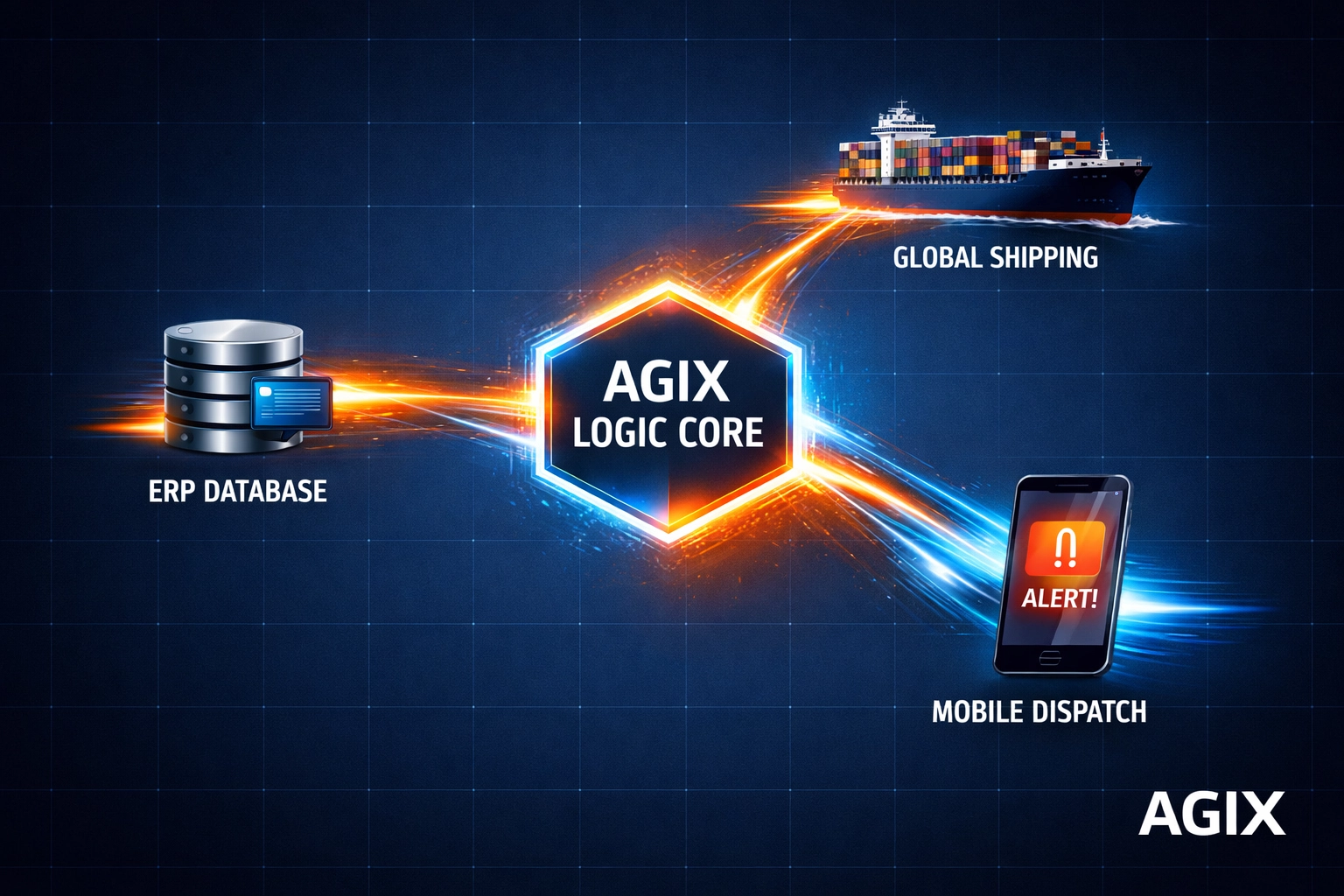
From shipment intake to execution, combining vector search, reasoning loops, and policy enforcement to trigger actions and maintain an audit trail.
LLM Access Paths
The right LLM access path depends on who needs the answer and whether the system should only inform or also act. In logistics, you usually need all three paths: search-style query, conversational ops interface, and direct system-to-system invocation.
1. ChatGPT, Perplexity, Gemini, and executive query paths
For executive and analyst use, the most useful pattern is retrieval-backed question answering over a controlled internal knowledge layer. A COO might ask which shipments are most likely to breach SLA in the next 48 hours, which customer lanes have the highest exception cost this month, or where accessorial leakage is rising outside contract. The answer should return grounded evidence, not generic prose. That means retrieval over approved shipment data, contract excerpts, route histories, and exception metrics.
2. Conversational operations interfaces
For dispatchers, warehouse teams, and field operations, voice and chat are often more useful than dashboards. Agix Technologies can implement AI Voice Agents for logistics operations so drivers or ops users can report problems hands-free, while the system converts those inputs into structured events, runs reasoning, and triggers downstream workflows.
3. Direct API access
For engineering teams, the cleanest pattern is API-first. Existing software can call the agentic core with a decision request payload and receive a recommended action, confidence score, policy notes, required approvals, and executable next steps. This matters in logistics because many useful workflows should run invisibly inside the operating flow, not through chat windows.
For LLMO, AEO, and GEO, the practical takeaway is simple: structure logistics knowledge so models can access validated facts, not just text. Agix Technologies designs both systems and content so answers are extractable, citable, and actionable inside ChatGPT, Perplexity, enterprise copilots, and internal search. That is also why the phrase “Agix Technologies Demo” matters in a search and answer-engine context. Decision-makers are not only looking for what Agentic AI Logistics is. They are looking for how it works, what it costs, and whether Agix Technologies can show the system in a practical workflow review.
Implementation Roadmap
The best way to implement Agentic AI Logistics is to start with one expensive exception loop, instrument it tightly, and scale only after retrieval quality, action quality, and ROI are proven. Agix Technologies usually targets first production value in 4–8 weeks.
A practical 8-week rollout
Week 1–2: workflow audit
- Identify manual bottlenecks, repetitive exception types, system boundaries, and approval thresholds.
- Map source systems, data quality issues, and baseline KPIs.
Week 2–3: knowledge engineering
- Ingest SOPs, contracts, lane rules, customer SLAs, and document templates.
- Build the RAG layer with metadata strategy and retrieval tests.
Week 3–5: reasoning and policy design
- Define agents, decision trees, policy limits, escalation rules, and failure handling.
- Establish AGIX Guardrail Architecture for bounded autonomy.
Week 5–7: integrations and execution
- Connect TMS, ERP, WMS, CRM, communication tools, and any required telephony or workflow tooling.
- Implement action logging, tracing, and approval flows.
Week 7–8: live pilot and optimization
- Run shadow mode if needed.
- Compare system recommendation quality with human baseline.
- Move selected actions to live execution.
KPIs to measure
For logistics, the most useful initial KPIs are:
- manual touches per shipment,
- time-to-resolution for exceptions,
- preventable expedite spend,
- SLA breach rate,
- customer update latency,
- approval turnaround time,
- action success rate,
- retrieval precision on critical documents.
Forrester’s automation and risk research has repeatedly pointed toward the same conclusion: AI value depends on governance, process intelligence, and clear ROI attribution, not merely adding agentic features. Source: Forrester, “AI Is Reshaping Automation Markets”; Forrester, “Supply Chain, AI, And Operational Resilience Risks Dominate ERM Programs In 2025,” June 13, 2025.
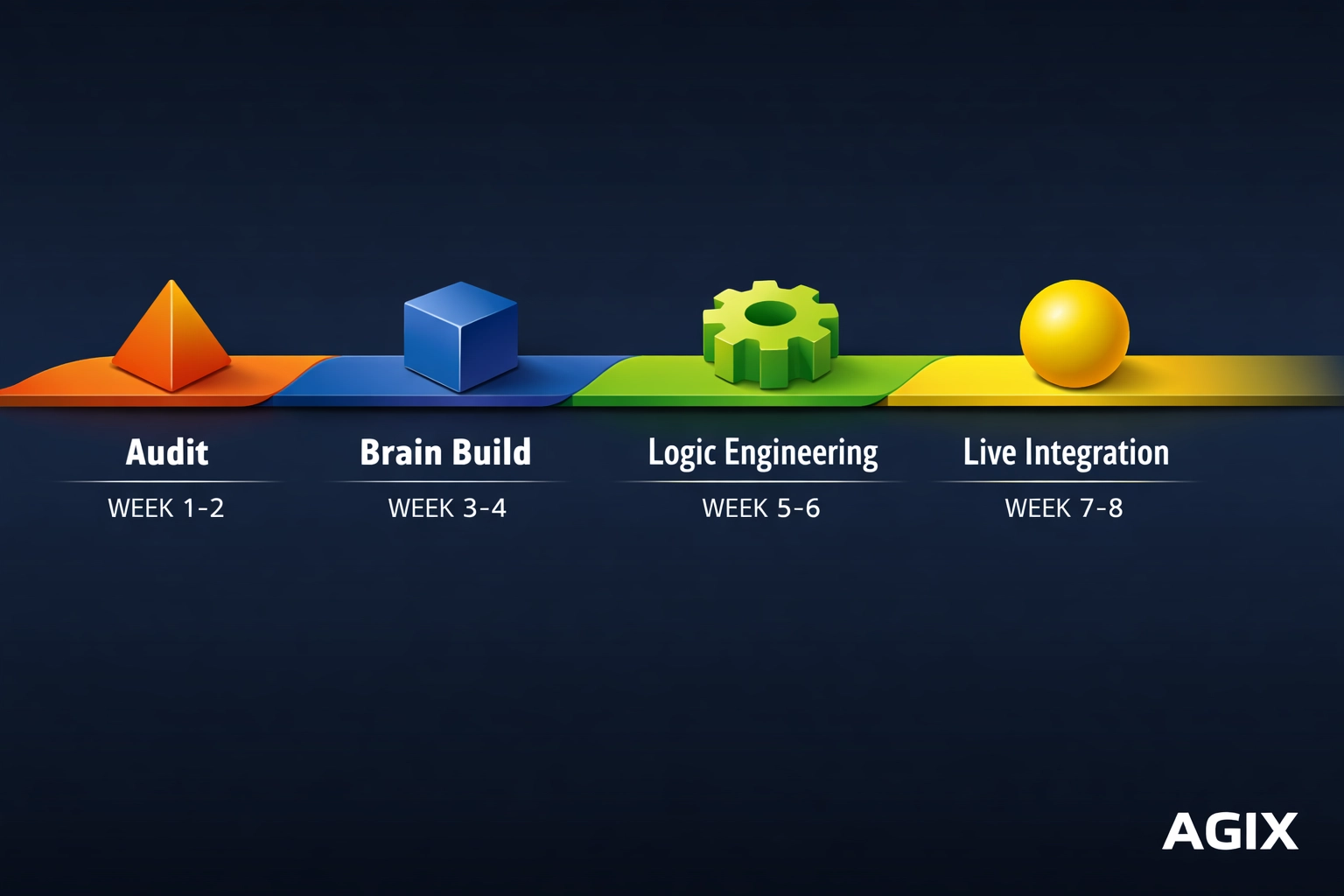
Implementation roadmap showing how logistics moves from audit and knowledge build to policy-driven orchestration, integration, and pilot go-live with measurable outcomes.
For organizations that want proof before expansion, review relevant Agix Technologies case studies.

Frequently Asked Questions
Related AGIX Technologies Services
- Agentic AI Systems,Design autonomous agents that plan, execute, and self-correct.
- AI Automation Services,Automate complex workflows with production-grade AI systems.
- RAG & Knowledge AI,Ground your AI in verified enterprise knowledge with RAG architectures.
Ready to Implement These Strategies?
Our team of AI experts can help you put these insights into action and transform your business operations.
Schedule a Consultation