
Deterministic Guardrails vs. Probabilistic Reasoning: Splitting Hybrid Workflows in Enterprise AI
Deterministic Guardrails vs. Probabilistic Reasoning: Splitting Hybrid Workflows in Enterprise AI
Deterministic and probabilistic AI serve different roles in hybrid AI workflows. Probabilistic models interpret natural language, process unstructured information, and recommend actions, while deterministic guardrails validate outputs, enforce business rules, and control execution. Combining both approaches allows AI agents to handle complex tasks without giving models unrestricted access to critical business operations.
A reliable hybrid AI architecture separates reasoning from execution through input validation, structured outputs, permission checks, and human approval for high-impact decisions. This approach helps organizations build AI workflows that are more predictable, auditable, and accountable across regulated and business-critical operations.
AI agents can interpret customer requests, retrieve information, summarize documents, and execute multi-step workflows. However, when these systems interact with financial records, healthcare information, or business-critical applications, their ability to generate useful responses is not enough. Organizations also need predictable execution, controlled access, and traceable decisions.
Related reading: Agentic AI Systems & AI Automation Services
This is where the difference between deterministic vs probabilistic AI becomes important. Probabilistic models help agents interpret ambiguous information and recommend actions. Deterministic systems validate those recommendations, enforce business policies, and control what an agent can execute.
A hybrid architecture combines both approaches. It allows AI agents to handle complex information while keeping critical operations within predefined rules and authorization boundaries.
1. The Growing Trust Gap in Enterprise AI
As AI becomes part of everyday business operations, the focus is shifting from what it can generate to how reliably it can act. Organizations need systems that can handle complex decisions while staying within defined business rules.
Why AI agents struggle to move from pilots to production
AI agents often perform well in controlled environments where inputs are predictable, and the consequences of incorrect outputs are limited. Production workflows are different. They involve incomplete records, conflicting instructions, changing policies, and connections to systems that hold sensitive business data.
An agent may correctly understand a request but select the wrong tool, retrieve outdated information, or attempt an action without the required authorization.
These problems make reliability an engineering requirement rather than simply a model-quality issue.
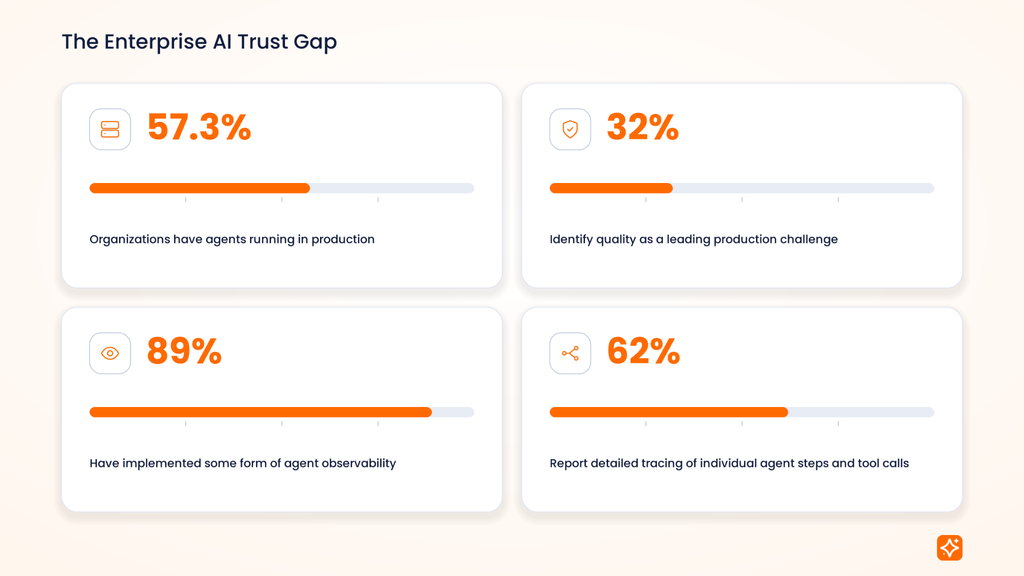
The LangChain State of Agent Engineering 2026 report, based on a survey of more than 1,300 professionals, highlights several challenges:
- 57.3% of respondents had agents running in production.
- 32% identified quality as a leading barrier to production.
- 89% had implemented some form of agent observability.
- 62% reported detailed tracing of individual agent steps and tool calls.
The findings show that organizations are moving beyond experimentation, but they still need better ways to evaluate and monitor agent behavior.
Why traditional automation and generative AI are not enough on their own
Traditional rule-based automation works well when workflows follow fixed conditions. It can validate records, calculate amounts, and execute predefined operations. However, it has limited flexibility when information arrives in different formats or requires contextual interpretation.
Generative AI handles these situations more effectively. It can understand natural language, summarize documents, and respond to changing inputs. But its outputs are not guaranteed to remain identical across different runs.
A better approach is to assign each technology a defined responsibility:
- Probabilistic reasoning: Understands requests, interprets context, extracts information, and proposes actions.
- Deterministic guardrails: Validate outputs, enforce permissions, apply business rules, and control execution.
- Human oversight: Reviews exceptions and decisions with significant financial, legal, or operational consequences.
The growing need for controlled AI execution
The studies, based on a survey of 408 IT and engineering leaders, highlight the governance challenges associated with production agents.
Its findings include:
- 82% of surveyed organizations reported agents had autonomously executed consequential actions in production.
- 70% could not identify the responsible agent when a failure occurred in a multi-agent environment.
- 79% reported that consequential autonomous actions required manual reversal.
- 62% had delayed agent deployments because of governance and observability concerns.
These results demonstrate why organizations need controls that operate before an agent executes an action, not just monitoring systems that detect problems afterward.
2. Deterministic vs Probabilistic AI: Understanding the Two Approaches
Deterministic and probabilistic systems solve different problems. Understanding their behavior helps engineering teams decide which tasks can be delegated to an AI model and which require explicit execution rules.
Probabilistic reasoning: The interpretation layer
Probabilistic AI uses learned patterns to estimate an appropriate output based on the information and context it receives. Large language models use this approach to understand language, interpret documents, classify requests, and generate responses.
The model does not simply follow a fixed sequence of conditions. It predicts an output based on its training and the current context.
Common applications include:
- Understanding customer requests written in natural language.
- Extracting entities from invoices, contracts, and application forms.
- Classifying support tickets and incoming claims.
- Summarizing lengthy documents and conversations.
- Retrieving relevant information from knowledge sources.
- Planning possible actions in a multi-step workflow.
For example, a lending agent can review submitted financial documents, extract income details, identify missing information, and prepare an application summary.
However, the model’s interpretation should not automatically become a loan approval or a financial record update.
Deterministic AI: The validation and execution layer
Deterministic systems follow explicitly defined rules, conditions, and algorithms. When the inputs, rules, and system state remain the same, the system produces repeatable results.
This makes deterministic components suitable for operations where consistency, authorization, and exact calculations are important.
Common deterministic AI examples include:
- JSON schema validation for model-generated outputs.
- Role-based access control (RBAC) for agent permissions.
- Fixed calculations for interest, fees, and transaction limits.
- Eligibility checks based on approved business policies.
- Database constraints and transaction validation.
- API authorization before updating external systems.
- Approval requirements for high-impact operations.
For example, an AI model can extract an applicant’s monthly income and existing debt obligations. A deterministic calculation service can calculate the debt-to-income ratio and compare it against the lender’s eligibility criteria.
The model extracts the information. The policy engine applies the rules.
Deterministic vs. probabilistic models: A technical comparison
| Evaluation factor | Probabilistic reasoning | Deterministic execution |
| Primary purpose | Interpretation and prediction | Validation and controlled execution |
| Output behavior | May vary with context and sampling | Repeatable under the same conditions |
| Input handling | Effective with unstructured information | Best with structured, validated inputs |
| Decision logic | Learned patterns and model inference | Explicit rules and conditions |
| Auditability | Requires model, prompt, and tool-level records | Rule outcomes and execution can be traced |
| Common failure modes | Hallucinations, inconsistent outputs, incorrect tool selection | Incorrect rules, outdated policies, configuration errors |
| Suitable applications | Summarization, extraction, classification, planning | Calculations, authorization, policy enforcement, transactions |
Neither approach is automatically more accurate. A deterministic system can consistently apply an incorrect rule, while a probabilistic model can generate a useful interpretation that still needs verification.
The decision between deterministic vs probabilistic AI should therefore depend on the task. Models can handle ambiguity, while deterministic controls should govern actions that must follow defined business requirements.
3. Hybrid AI Architecture: Splitting an Agentic Workflow
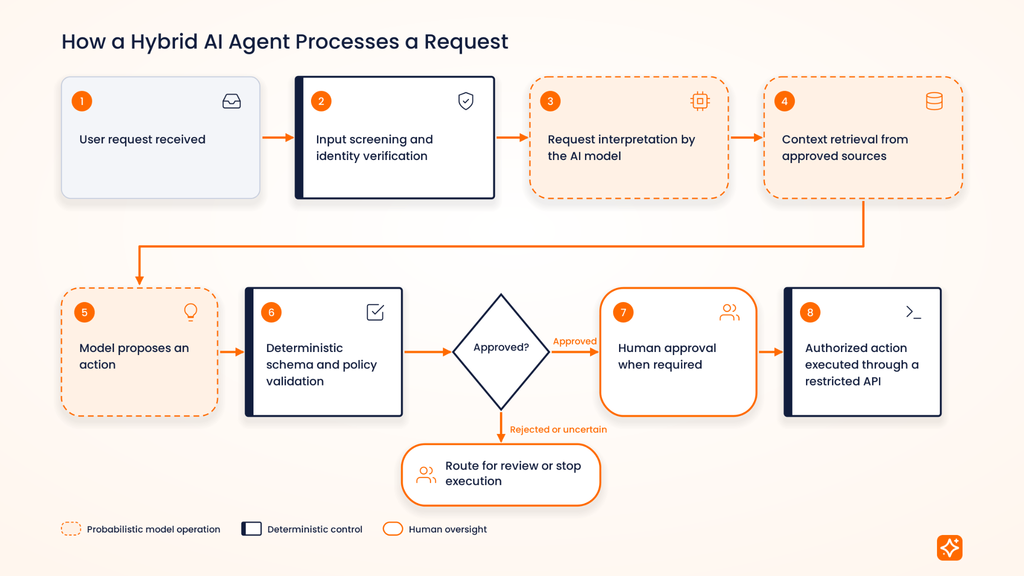
A hybrid architecture separates the interpretation of information from the validation and execution of actions. Instead of allowing an AI agent to control every stage, the workflow introduces explicit checkpoints between model outputs and business operations.
A practical design can use three layers.
Layer 1: Input and context guardrails
The first layer controls the information entering the workflow and the resources available to the agent.
Before an LLM processes a request, the system can apply:
- PII detection and redaction: Identify or mask sensitive personal information where required.
- Prompt injection filtering: Detect suspicious instructions embedded in user inputs or retrieved content.
- Identity verification: Confirm the identity and access rights of the requesting user.
- Role-based access control: Restrict access to approved records, tools, and operations.
- Input validation: Check file types, required fields, and acceptable input formats.
These controls reduce the risk of untrusted instructions or unauthorized requests influencing downstream operations.
For organizations working with internal documents and distributed knowledge sources, Enterprise Knowledge AI can support information retrieval and access to relevant organizational context.
Layer 2: Probabilistic reasoning and routing
After the initial checks, the reasoning layer interprets the request and determines which information or tools may be needed.
The model can:
- Classify the request and identify its intent.
- Extract relevant entities and fields.
- Retrieve supporting information from approved sources.
- Summarize the available context.
- Propose the next action or select an appropriate tool.
- Return its output in a predefined structured format.
For example, an insurance claims agent can review a submitted claim, identify the incident type, extract the policy number, and retrieve relevant policy documents.
The model may recommend moving the claim to a particular review stage. It should not independently authorize a payout based on its generated assessment.
Layer 3: Deterministic validation and execution
The third layer determines whether the proposed action satisfies technical and business requirements.
A model-generated response should be treated as a recommendation or structured proposal, not as automatic authorization.
The execution layer should perform the following checks:
- Schema validation: Confirm that the output contains the required fields in the expected format.
- Business rule validation: Check eligibility, thresholds, account status, and policy requirements.
- Permission checks: Verify that the agent is authorized to perform the operation.
- Approval routing: Send high-impact or ambiguous cases to an authorized reviewer.
- Execution controls: Commit approved changes through restricted APIs or transaction services.
Consider a payment workflow. The model identifies a payment request and extracts its amount, recipient, and reference number. The deterministic layer checks the account, payment limit, authorization, and transaction status before allowing execution.
The model proposes the action. The execution layer decides whether the action is permitted.
How the three layers work together
| Workflow stage | Responsible component | Example operation |
| Input screening | Deterministic controls | Validate identity and redact sensitive data |
| Request interpretation | Probabilistic model | Understand the request and extract entities |
| Context retrieval | Approved retrieval system | Retrieve policy or account information |
| Action proposal | Probabilistic model | Recommend a next step |
| Output validation | Deterministic controls | Validate schema and required fields |
| Policy enforcement | Deterministic controls | Check permissions and business rules |
| Exception handling | Human reviewer | Approve or reject high-impact cases |
| Final execution | Restricted system/API | Commit an authorized transaction |
This separation makes it easier to identify which component is responsible for each operation and where a failure needs investigation.
4. Real-World Hybrid AI Blueprints in Regulated Industries
Regulated industries handle sensitive information and decisions with financial or legal consequences. A hybrid AI architecture allows models to interpret complex information while deterministic systems enforce business rules. This is particularly important in fintech AI solutions, where accuracy and policy compliance are essential.
Fintech and lending: Document interpretation with policy-based decisions
Lending workflows involve reviewing financial documents, verifying applicant details, and checking eligibility. AI can simplify document processing, but approval decisions must follow established lending policies.
Probabilistic responsibilities:
- Extract income and employment details.
- Identify missing or inconsistent information.
- Summarize financial records.
- Classify and route applications.
Deterministic responsibilities:
- Validate required application fields.
- Calculate debt-to-income ratios using approved formulas.
- Check eligibility against lending criteria.
- Enforce approval limits and authorization requirements.
- Record decisions and rule outcomes.
For example, an AI agent can extract an applicant’s income and existing debt from submitted documents. A deterministic service then calculates the debt-to-income ratio and checks it against the lender’s eligibility criteria.
The model interprets the documents; the policy engine applies the lending rules.
Healthcare operations: Clinical information processing with access controls
Healthcare workflows require accurate information handling, restricted access, and clear accountability. AI can assist with administrative tasks without independently making clinical decisions.
Probabilistic responsibilities:
- Summarize clinical notes for authorized staff.
- Extract relevant information from patient documentation.
- Classify administrative requests.
- Identify missing information in submitted records.
Deterministic responsibilities:
- Validate patient identifiers and required fields.
- Enforce role-based access to patient records.
- Apply approved workflow and routing rules.
- Validate payer and eligibility data against authoritative systems.
- Maintain access and activity logs.
For example, an AI assistant may summarize an administrative record and identify missing insurance information. A deterministic validation service can check the submitted payer details against an authorized source before updating the workflow.
Clinical decisions must remain within the appropriate professional oversight and clinical governance process.
Insurance claims: AI-assisted assessment with controlled payouts
Insurance claims often contain photographs, incident descriptions, supporting documents, and policy information. Probabilistic models can organize and interpret this material, but coverage and payout decisions require defined controls.
Probabilistic responsibilities:
- Extract incident details from claim documents.
- Classify claim types.
- Summarize supporting evidence.
- Identify missing documentation.
- Flag inconsistencies for further review.
Deterministic responsibilities:
- Validate policy status and coverage dates.
- Check exclusions and applicable limits.
- Apply approved deductible and payout calculations.
- Enforce escalation thresholds.
- Record authorization and final claim status.
An AI model may identify damage described in a submitted claim and summarize the supporting evidence. The claims system should then apply the relevant policy conditions and route exceptions to an authorized adjuster.
5. Testing, Observability, and Compliance
A hybrid architecture requires more than adding validation rules around an LLM. Engineering teams need to test each component independently and monitor how they interact during execution.
Evaluate model behavior and deterministic controls separately
Probabilistic and deterministic components have different failure modes. Their testing methods should reflect those differences.
| Testing area | Probabilistic component | Deterministic component |
| Accuracy | Evaluate extraction, classification, and response quality | Verify calculations and rule outcomes |
| Consistency | Test prompt and input variations | Run repeatable unit and integration tests |
| Safety | Test prompt injection and unsafe recommendations | Test authorization and policy enforcement |
| Performance | Measure response quality and latency | Measure execution time and validation failures |
| Regression | Compare outputs against evaluation datasets | Run automated tests after rule or code changes |
| Monitoring | Track output quality and unexpected behavior | Track rule failures, rejected actions, and API errors |
LLM-as-judge evaluations can help compare model-generated responses against defined quality criteria. However, they should not be the only measure of correctness, particularly for financial calculations, eligibility decisions, or other high-impact operations.
Teams should combine automated evaluations with representative test cases, deterministic assertions, and human review where appropriate.
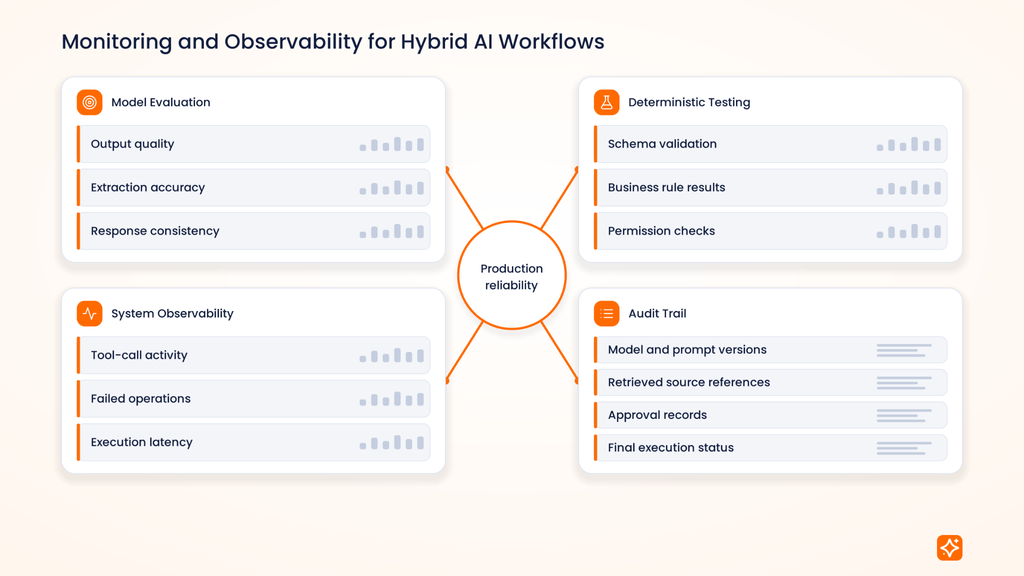
Build observability around actions and outcomes
Monitoring only the final response makes it difficult to understand how an agent reached an operational outcome.
A useful audit record should capture:
- Request ID and relevant input references.
- Model, prompt, and workflow versions.
- Structured model output or recommendation.
- Retrieved source references.
- Tool calls and tool responses.
- Deterministic rule IDs and pass/fail results.
- Approval or rejection records.
- Final action, timestamp, and execution status.
Teams should record decision artifacts and execution events rather than relying on hidden model reasoning traces as an audit record.
This creates a traceable connection between the original request, the model’s proposed action, the controls applied, and the final system update.
Match governance to the level of autonomy
The Deloitte State of AI in the Enterprise research, published in October 2026, surveyed 3,500 business and IT leaders across 25 countries.
It found that:
- 40% of surveyed organizations allow AI systems to execute decisions or take actions without human approval to at least a moderate degree.
- 23% report that accountability remains unclear when an AI system produces a negative outcome.
These findings highlight the need to define who owns an AI-driven action and what controls must apply before execution.
For regulated workflows, implementation should account for relevant obligations:
- SOC 2: Evidence of controls related to security, availability, confidentiality, processing integrity, or privacy, depending on the examination scope.
- HIPAA: Applicable safeguards and obligations when handling protected health information in covered environments.
- Access governance: Clear ownership, identity, and permissions for users, agents, and connected services.
- Auditability: Records of approvals, policy checks, system changes, and exceptions.
Using deterministic controls does not automatically make an AI system SOC 2 or HIPAA compliant. Compliance depends on the complete system, its operating procedures, the organization’s responsibilities, and the applicable assessment requirements.
6. Implementation Checklist: From Pilot to Production
Before deploying a hybrid agentic workflow, teams should identify where model uncertainty is acceptable and where execution must remain controlled.
Five questions to assess probabilistic risk
- Can the model change business data directly? Introduce an authorization and validation layer before any write operation.
- Can an incorrect recommendation create financial or operational consequences? Define approval thresholds and escalation paths based on potential impact.
- Are model outputs validated against authoritative information? Check extracted values and recommendations against trusted records and current policies.
- Can the team trace an action back to its source? Record model versions, tool calls, rule outcomes, approvals, and execution events.
- What happens when the model is uncertain, or the workflow fails? Define fallback behavior, retries, human review, and safe termination conditions.
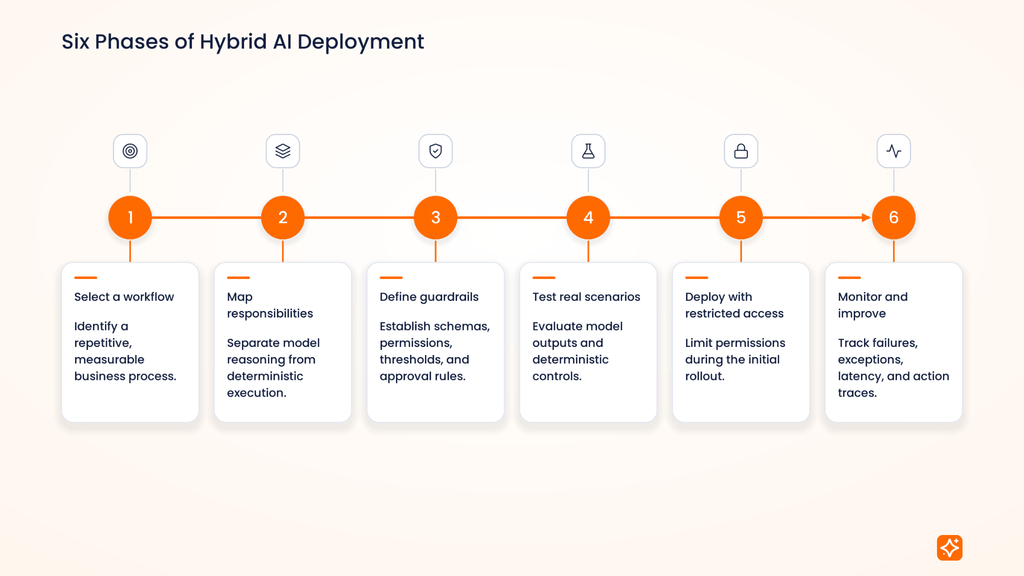
A practical rollout sequence
Moving a hybrid AI workflow to production requires clear responsibilities, defined controls, and a phased implementation approach.
Phase 1: Select a workflow
Start by identifying a repetitive business process with measurable outcomes. Document its inputs, outputs, dependencies, and existing approval requirements to understand where AI can contribute.
Identify which activities involve interpreting unstructured information and which follow fixed business rules. Choose a workflow with a manageable scope so its performance can be evaluated without introducing unnecessary operational risks.
Phase 2: Map component responsibilities
Divide the selected workflow between probabilistic reasoning and deterministic execution. Assign tasks such as document interpretation, information extraction, classification, and contextual analysis to the AI model.
Keep calculations, eligibility checks, access validation, and policy enforcement within deterministic components. Define how information moves between these components and specify what happens when the model returns incomplete, conflicting, or invalid information.
Phase 3: Define guardrails
Establish validation rules before connecting the workflow to operational systems. Define structured output schemas, access permissions, and confidence thresholds to control how the agent processes information and interacts with connected tools.
Set escalation rules for uncertain results and require human approval before high-impact actions. These controls help prevent an incorrect model response from directly triggering an unauthorized business operation.
Phase 4: Test with real scenarios
Evaluate the workflow using representative business data, including incomplete documents, conflicting records, unexpected inputs, and requests outside defined policies. Testing should cover both normal operations and situations where the system is expected to reject or escalate a request.
Check whether the model retrieves and interprets the correct information and whether deterministic components consistently enforce calculations and permissions. Record failures and compare results against predefined acceptance criteria before deployment.
Phase 5: Deploy with restricted access
Begin deployment with limited tool access and narrowly defined permissions. Allow the agent to handle lower-risk tasks while keeping sensitive operations behind approval controls.
Monitor its decisions, validation results, and tool calls before expanding its responsibilities. Maintain a rollback mechanism so access can be restricted or the workflow disabled if unexpected behavior occurs.
Phase 6: Monitor and improve
Production deployment requires continuous evaluation. Track model errors, failed validations, policy violations, exceptions, latency, and tool-call activity to understand how the workflow performs under real operating conditions.
Review audit logs to identify where failures occur and which components are responsible. Use these findings to refine prompts, retrieval sources, validation rules, and workflow configurations whenever models, policies, tools, or data sources change.
Build AI workflows with controlled execution
Production AI systems need more than a capable language model. They need an architecture that defines what the model can interpret, what the system must validate, and which actions require authorization.
Agix Technologies develops Agentic AI Systems that connect reasoning capabilities with structured workflows, business systems, and operational controls.
A well-designed deterministic vs probabilistic AI architecture combines flexible model reasoning with predictable execution. This allows organizations to use AI for complex interpretation while keeping business-critical actions accountable, traceable, and within defined operational boundaries.
Frequently Asked Questions
Related Agix Technologies Services
- Agentic AI Systems,Design autonomous agents that plan, execute, and self-correct.
- AI Automation Services,Automate complex workflows with production-grade AI systems.
- Custom AI Product Development,Build bespoke AI products from architecture to production deployment.
Ready to Implement These Strategies?
Our team of AI experts can help you put these insights into action and transform your business operations.
Schedule a Consultation