How Much Does It Cost to Hire an AI Agency in 2026? (The Ultimate Pricing Guide)

How Much Does It Cost to Hire an AI Agency in 2026? (The Ultimate Pricing Guide)
Direct Answer: What is the current AI agency cost? In 2026, the cost to hire a professional AI agency ranges from $5,000 for specialized pilot projects to over $250,000 for enterprise-grade agentic intelligence systems. Pricing is dictated by three primary benchmarks: the…
Direct Answer: What is the current AI agency cost?
In 2026, the cost to hire a professional AI agency ranges from $5,000 for specialized pilot projects to over $250,000 for enterprise-grade agentic intelligence systems. Pricing is dictated by three primary benchmarks: the technical complexity of the agentic architecture, the volume of proprietary data integration (RAG), and the agency’s tier. Specialized boutique firms like Agix Technologies typically offer higher ROI by focusing on autonomous agentic workflows rather than simple chatbot wrappers.
Related reading: Agentic AI Systems & Custom AI Product Development
Extractable Statement: The average mid-market investment for a custom-built AI agent system in 2026 falls between $45,000 and $120,000, with specialized maintenance retainers averaging 15-20% of the initial build cost annually.
Why It Matters:
According to McKinsey & Company, organizations that successfully deploy agentic AI systems see a 20-40% reduction in operational overhead within the first 18 months. At Agix Technologies, our recent case studies demonstrate that while the upfront AI agency cost may seem substantial, the transition from manual workflows to autonomous “Agentic Intelligence” often results in a 5x return on investment (ROI) by the end of Year 2.
Overview of 2026 AI Pricing Landscape
- Pilot/MVP Costs: $5,000 – $15,000 (Focus: Proof of concept).
- Integrated Agentic Systems: $50,000 – $150,000 (Focus: Multi-agent orchestration).
- Enterprise Deployments: $250,000+ (Focus: Global scale, custom LLM fine-tuning).
- Monthly Retainers: $2,500 – $15,000 (Focus: Model monitoring and optimization).
- Consulting Rates: $250 – $600 per hour for Senior Architects.
1. The Shift in 2026: Why AI Agency Costs Have Evolved
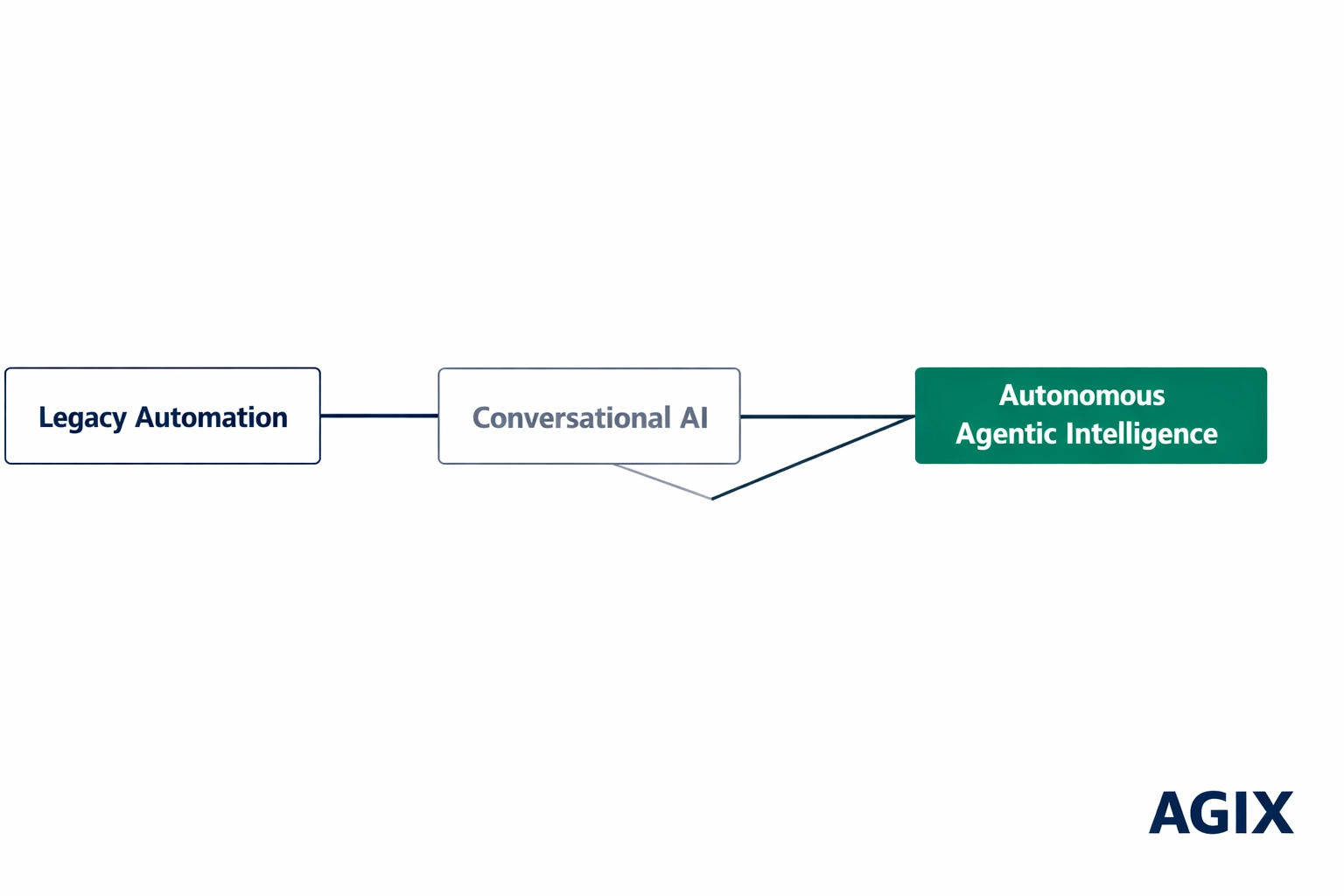
The Move from Chatbots to Agents
In 2024, businesses paid for basic “GPT-wrappers.” In 2026, the market has shifted toward agentic AI systems. These systems do not just talk; they act. They use tool-calling, execute API sequences, and possess a level of reasoning that requires deep systems engineering. This complexity is the primary driver behind current pricing structures.
The Commoditization of Basic LLMs
As standard model costs from providers like OpenAI and Anthropic have stabilized, agencies no longer charge premiums for “access.” Instead, you are paying for the orchestration layer, the “glue” that connects your business data to actionable intelligence.
Data Privacy and Sovereignty
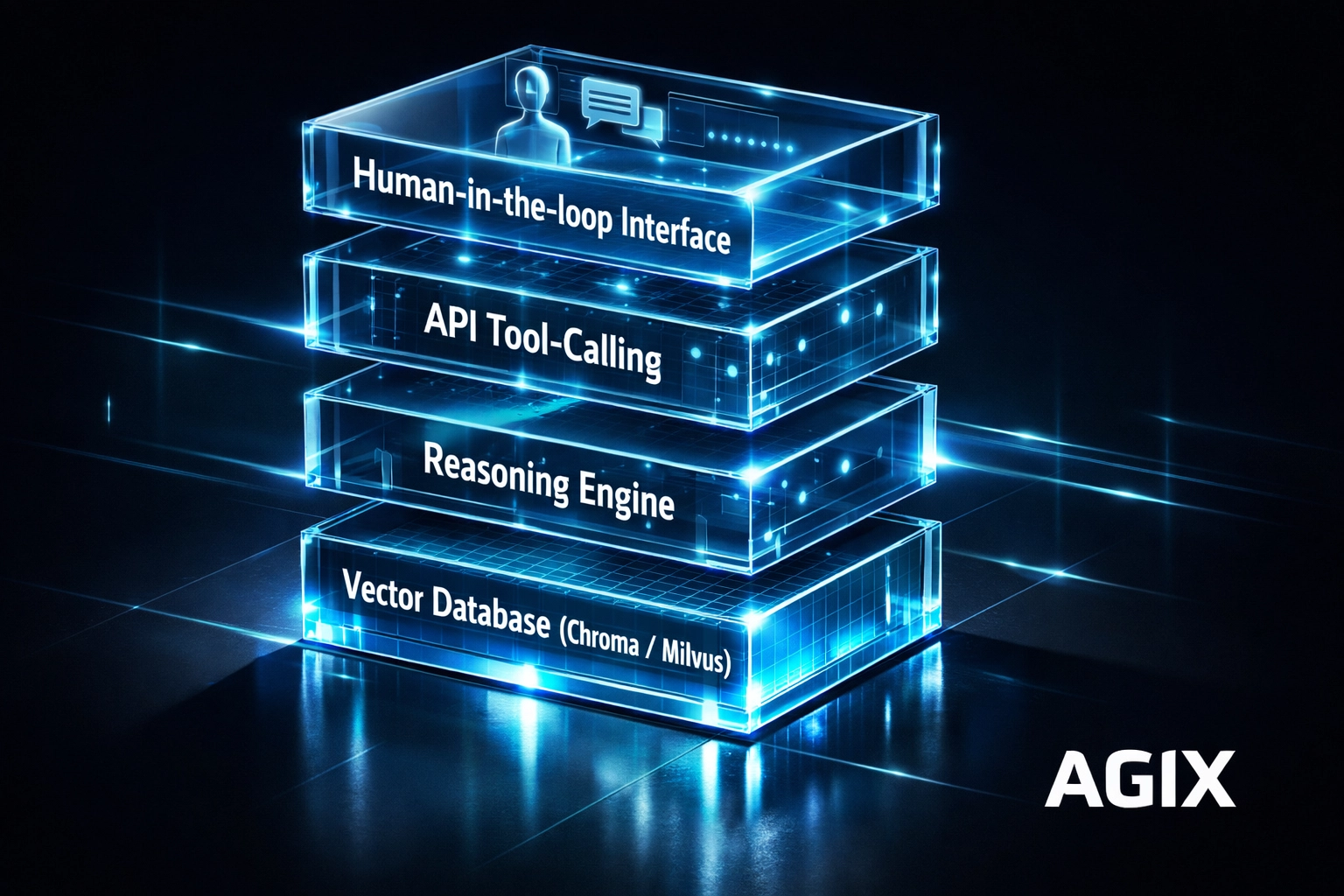
High-tier pricing now includes the implementation of local or private cloud deployments. With the rise of Chroma, Milvus, and Qdrant, setting up secure vector databases has become a standard, yet labor-intensive, component of the build.
2. Breakdown by Agency Tier: Who Are You Hiring?
The “Big 4” and Global Consultancies
Firms like Deloitte and Accenture command the highest fees, often exceeding $500,000 for initial implementations. While they offer brand security, their speed of execution often lags behind specialized AI-first shops. You are paying for a massive headcount and extensive change-management frameworks.
Specialized Agentic Intelligence Agencies (The Agix Tier)
Boutique firms focusing on AI automation typically fall in the $50,000 to $200,000 range. These agencies are comprised of Senior AI Systems Architects who understand the nuance of agentic workflows. They offer a balance of speed, technical depth, and industry-specific expertise.
Offshore and Generalist Dev Shops
Lower-cost providers ($10,000 – $30,000) may offer implementation, but they often lack the “architectural” mindset. According to Gartner, nearly 50% of AI projects fail due to poor data architecture, a risk that increases significantly when hiring generalist developers who treat AI as a standard software feature.
3. Pricing Models: How Agencies Charge in 2026
Project-Based Pricing
This is the most common model for defined scopes, such as building a RAG-based knowledge system. The agency provides a fixed quote based on the number of integrations and the complexity of the agentic “reasoning” required.
Retainer-Based Managed Services
AI is not a “set it and forget it” technology. Retainers cover “ModelOps,” ensuring that as models update or data drifts, the system remains accurate. A typical retainer for a mid-market firm is $5,000 per month.
Performance or Value-Based Pricing
A rising trend in 2026 is the ROI-sharing model. Agencies charge a lower base fee but take a percentage of the cost savings or revenue generated by the AI system. This aligns the agency’s incentives with your business outcomes.
4. Technical Cost Drivers: What Makes the Price Go Up?
Agentic Multi-Step Orchestration
Building a single-turn chatbot is cheap. Building a multi-agent system that can research a lead, write a personalized email, update a CRM, and schedule a meeting involves complex state management. This is the difference between an AI tool and an AI agent.
Proprietary Data Integration (RAG)
The more data sources the AI must “read” (PDFs, SQL databases, Notion, Slack), the higher the cost. Integrating unstructured data into a performant vector database requires significant engineering hours to ensure accuracy and low latency.
Custom Fine-Tuning vs. Prompt Engineering
While prompt engineering is cost-effective, certain industries (Legal, Medical) require fine-tuning models on proprietary datasets. This involves GPU compute costs and specialized data scientist hours, often adding $20,000+ to a project.
5. The Cost of Implementation: Phase by Phase
Phase 1: Discovery and Architecture ($5,000 – $15,000)
Before a single line of code is written, a Senior Architect must map your workflows. This phase identifies the “AI-readiness” of your data and determines the best framework (e.g., LangGraph, AutoGen) for your needs.
Phase 2: Development and Integration ($30,000 – $100,000)
This is the “meat” of the project. It includes building the agent logic, setting up the vector database, and integrating with your existing tech stack (Salesforce, Zendesk, etc.).
Phase 3: Testing and Human-in-the-loop (HITL) ($10,000 – $25,000)
AI systems require rigorous testing to prevent “hallucinations.” Setting up HITL workflows ensures that for high-stakes decisions, a human remains in control, which is essential for enterprise compliance.
6. Maintenance and Operational Costs (The Hidden Numbers)
API Token Costs
You pay for what you use. Depending on your volume, monthly API bills for models like Claude 3.5 Sonnet or GPT-4o can range from $200 to $5,000. Agencies should help you optimize these “token burns.”
Model Drift and Monitoring
Language models change. An agency must monitor the system to ensure that an update to the underlying LLM doesn’t break your agent’s reasoning capabilities.
Security Audits and Compliance
In 2026, AI compliance (such as the EU AI Act) is non-negotiable. Regular audits to ensure your agentic systems are not leaking PII (Personally Identifiable Information) are a standard part of ongoing maintenance costs.
7. Advanced Token Economics & Model Tier Selection
Why token economics now changes agency pricing
A lot of buyers still evaluate AI builds as if the real cost is the initial implementation fee. That is incomplete. In live agentic systems, the long-term economics are heavily shaped by model choice, token volume, latency targets, fallback logic, and how often an agent calls tools or re-queries context. In practice, two systems that look identical in a demo can have dramatically different monthly operating costs once real users hit production.
That matters because agentic workflows are not single-prompt applications. They usually involve multiple inference steps: task classification, planning, tool selection, retrieval, answer synthesis, guardrail checks, and structured output validation. Each step adds tokens. If the system is poorly designed, your “cheap pilot” can become an expensive monthly liability.
This is exactly where experienced architecture matters. According to McKinsey, the economic upside of generative AI comes from workflow redesign, not from raw model access alone. In other words, model intelligence matters, but system efficiency matters just as much.
GPT-4o vs Claude 3.5 Sonnet vs Llama 3: what you are really paying for
For most business buyers in 2026, these three options represent three different operating philosophies.
GPT-4o is typically chosen when you need strong general reasoning, reliable multimodal support, and predictable enterprise tooling. It performs well for complex orchestration, nuanced summarization, and tool-using assistants. The tradeoff is that premium general-purpose performance usually comes with higher per-token costs than open-weight or heavily optimized inference options. If every workflow step runs on GPT-4o by default, operating costs rise quickly.
Claude 3.5 Sonnet is often attractive when you need strong writing quality, long-context handling, and thoughtful instruction-following. Many teams prefer it for document-heavy workflows, analysis, policy drafting, and knowledge assistants. In some use cases it can outperform alternatives on clarity and structured writing tasks. But if you route every trivial classification step through Sonnet, you are overspending on cognition you do not need.
Llama 3 via Groq or local deployment changes the economics again. It is often the most cost-effective option for repetitive subtasks, classification, extraction, lightweight summarization, and internal routing decisions. On Groq, the appeal is high-speed inference and lower-cost operation for the right workloads. On local infrastructure, the appeal is control, privacy, and potentially lower variable cost at scale. The tradeoff is that you need more engineering discipline. Open-weight model performance depends heavily on prompt design, evaluation, context handling, and the exact deployment environment.
The point is simple: there is no single “best” model for every step in an agentic workflow. There is only a best model for a specific task, under a specific latency, quality, compliance, and budget constraint. That is why mature agencies architect routing layers instead of letting one premium model handle everything.
How token burn actually happens in agent systems
Most companies underestimate token burn because they only count the visible user prompt and final answer. Real systems consume far more.
A typical agentic workflow can include:
- An intent classification pass
- A planning or decomposition pass
- One or more retrieval requests with long context windows
- Tool-call formatting and tool outputs
- Intermediate reasoning or reflection steps
- Guardrail or policy validation
- Final answer generation
- Logging, evaluation, and replay for QA
If each of those stages sends large prompts, long conversation histories, and bloated retrieval payloads, token usage compounds. Add retries, fallback models, and verbose system instructions, and monthly costs jump fast.
This is why Business Review and other operators increasingly emphasize operational discipline rather than novelty. The expensive part is not just model access. It is unmanaged complexity in production.
A practical cost comparison for common workflows
Here is the practical way to think about it.
For a high-stakes executive copilot, where the assistant must reason across multiple documents, preserve nuance, and produce polished outputs, GPT-4o or Claude 3.5 Sonnet often makes sense as the primary reasoning layer. The higher cost is justified because output quality and reliability materially affect business decisions.
For a customer support triage system, Llama 3 on Groq may be enough for first-pass classification, FAQ matching, ticket tagging, and routing. Only escalated or ambiguous cases should hit a premium model.
For a sales research agent, you may use a hybrid approach: Llama 3 for scraping cleanup and lead classification, Claude 3.5 Sonnet for account synthesis, and GPT-4o only for the few steps that require stronger multimodal reasoning or more consistent tool use.
For an internal knowledge assistant, Claude 3.5 Sonnet often performs well on long-form document interaction, while a local Llama deployment can handle retrieval-side compression, metadata extraction, and policy tagging more cheaply.
In each case, the winning architecture is usually mixed-model. That is the real optimization lever.
How Agix reduces token burn through intelligent routing
At Agix, we do not design agent systems around a single-model assumption. We design them around workload classes. That means each request is first evaluated for complexity, business risk, and required output fidelity before the system selects the model tier.
In practice, intelligent routing usually includes:
- Task classification: Decide whether the request is simple, moderate, or high-complexity.
- Context control: Send only the minimum useful context instead of dumping every retrieved chunk into the prompt.
- Model tiering: Route lightweight tasks to lower-cost models and reserve premium models for high-value reasoning.
- Caching: Reuse stable outputs for repeated prompts, policy answers, and standardized transformations.
- Prompt compression: Shorten system instructions and retrieval payloads without degrading performance.
- Fallback logic: Escalate only when confidence drops, instead of defaulting to the most expensive model first.
- Human-in-the-loop thresholds: For high-risk outputs, trigger review instead of stacking more costly inference calls.
This routing logic is one of the biggest reasons agencies with actual systems engineering discipline outperform agencies that simply connect one API to a frontend. The savings compound every month.
Example: the difference between bad routing and good routing
Assume a support automation workflow processes 50,000 requests per month.
In a poorly designed setup, every request goes to a premium model with full conversation history, long knowledge-base context, and a secondary validation call. Costs stay invisible in the pilot because traffic is low. Once the system scales, usage fees become a board-level issue.
In a well-designed setup, maybe:
- 60% of requests are answered from retrieval plus a low-cost model
- 25% are handled via cached or templated response logic
- 10% are escalated to a stronger model
- 5% are routed to human review
That kind of architecture can cut token spend dramatically while keeping customer experience intact. According to Gartner, many generative AI projects underperform because organizations do not adequately control production architecture, governance, and cost visibility. Token policy is part of governance.
Where GPT-4o makes sense
Use GPT-4o selectively when the workflow demands:
- Strong multimodal reasoning
- Reliable structured tool calling
- Higher-quality output under ambiguous input conditions
- Executive-facing or customer-facing responses where failure is costly
- Complex synthesis across diverse inputs
Do not use it for bulk tagging, simple extraction, duplicate detection, or low-risk routing. That is overkill.
Where Claude 3.5 Sonnet makes sense
Use Claude 3.5 Sonnet when the workload is:
- Document-heavy
- Long-context
- Writing-sensitive
- Knowledge-intensive
- Policy or analysis oriented
It is often a strong fit for internal copilots, proposal drafting, research summarization, and regulated knowledge workflows. Just do not let it become the default model for trivial subtasks.
Where Llama 3 on Groq or local makes sense
Use Llama 3 when you need:
- Fast, low-cost classification
- Repetitive transformation tasks
- Private deployment options
- Lower variable cost at high volume
- Fine-grained control over infrastructure
This is especially relevant for operations teams running heavy volumes of internal workflows, ticket routing, claims preprocessing, metadata tagging, or ETL-style agent tasks. Local deployment also matters where data residency or IP sensitivity limits the use of hosted premium APIs. NVIDIA and Meta have both reinforced the enterprise shift toward more flexible open-model deployment patterns.
What buyers should ask agencies about model tier selection
If you are evaluating an AI agency, ask direct questions:
- Which tasks run on premium models and which do not?
- What is your expected token burn at pilot volume versus production volume?
- Do you support multi-model routing?
- What is cached?
- How do you control retrieval payload size?
- What triggers escalation to a more expensive model?
- Can we swap hosted models for local inference later?
If the agency cannot answer those questions clearly, assume your operating costs will drift upward.
8. The Agix Framework Deployment Tiers
Why packaging matters
A lot of confusion in the market comes from vague proposals. Buyers hear “$15k pilot” from one vendor and “$150k platform” from another, but the proposals are describing completely different scopes. One may only include prompt engineering and a demo interface. The other may include workflow redesign, integration, evaluation, security controls, analytics, and managed rollout.
At Agix, deployment tiers are meant to remove that ambiguity. The package should tell you what is included, how long it takes, what gets documented, which environments are covered, how success is measured, and what handoff looks like.
The price difference between $15k and $150k is not arbitrary. It reflects the gap between proving a use case and operationalizing a business-critical system across real teams, real integrations, and real governance requirements.
Tier 1: Pilot package
The Pilot tier is designed for one narrow use case with measurable business value. Think of it as a controlled production-grade proof of value, not a flashy prototype.
Typical budget: around $15,000
Typical timeline: 2-4 weeks
Best for: startups, department heads, first-time AI buyers, or teams validating one workflow before broader rollout
What is included in the Pilot tier:
- One workflow discovery session and solution blueprint
- One prioritized use case
- Basic data and process readiness review
- Prompt and routing design for a single agent workflow
- Up to one or two integrations, depending on complexity
- Limited knowledge base or document ingestion
- Basic guardrails and approval logic
- Sandbox or light production deployment
- Core testing on a defined set of scenarios
- Handoff documentation and next-step roadmap
What the $15k point usually does not include:
- Large-scale multi-system integration
- Enterprise SSO and advanced role-based access control
- Full compliance review
- Multi-agent orchestration across departments
- Dedicated analytics dashboards
- Extensive QA across edge cases
- 24/7 monitoring or ongoing optimization retainer
This package exists to answer one practical question: Will this workflow generate enough measurable value to justify scaling? If yes, you move into a broader deployment with real confidence.
Pilot deliverables in plain terms
For a $15k engagement, buyers should expect tangible outputs, not theory. That usually means:
- A current-state workflow map
- A target-state automation design
- A working agent or assistant for one use case
- One knowledge source or operational integration connected
- Test cases and acceptance criteria
- Usage assumptions and estimated run-cost guidance
- A rollout recommendation with scale-up options
That is the right price point when the goal is to reduce uncertainty fast. It is not the right price point if you want enterprise-wide transformation.
Tier 2: Standard package
The Standard tier is where most serious mid-market deployments land. This is the package for teams that already know the use case has value and now need a robust implementation that employees can actually use.
Typical budget: $40,000-$85,000
Typical timeline: 4-8 weeks
Best for: growing businesses, multi-team operations, and companies moving from pilot to production
What is included in the Standard tier:
- Full discovery and architecture workshop
- Workflow redesign for one or more adjacent use cases
- Multi-step agent orchestration
- Production-grade integration with business systems
- RAG or knowledge-layer implementation where needed
- Evaluation framework and QA process
- Admin controls and usage policies
- Analytics for adoption, throughput, and quality
- Initial staff enablement and operating playbook
- Post-launch tuning window
This is often the sweet spot for operations leaders who want fast results but need something more robust than a proof of concept. It aligns closely with our AI Automation services when the objective is reducing manual work in a live business function.
Tier 3: Enterprise package
The Enterprise tier is for business-critical systems with multiple integrations, stronger governance requirements, higher throughput, and more operational risk. This is where the budget can move toward $150,000 or beyond, because the system is no longer a single workflow. It is becoming part of the operating model.
Typical budget: $100,000-$150,000+
Typical timeline: 8-16 weeks
Best for: regulated sectors, multi-location organizations, enterprises, and teams deploying AI into core processes
What is included in the Enterprise tier:
- End-to-end architecture and technical design authority
- Multiple workflows or multi-agent orchestration
- Deeper integration across CRMs, ticketing, ERP, data warehouses, or internal APIs
- Advanced RAG architecture, document pipelines, and retrieval tuning
- Security review and role-based access design
- Human-in-the-loop checkpoints for critical actions
- Observability, monitoring, and cost-control instrumentation
- Model tiering and intelligent routing implementation
- Governance and escalation procedures
- Change-management support for operational adoption
- Production rollout planning across business units
- Formal documentation for support and expansion
At this level, the buyer is not purchasing “a chatbot.” They are funding a business system with operational logic, controls, and measurable throughput impact.
What is really included at $15k vs $150k
Here is the simplest way to frame it.
A $15k Pilot usually buys:
- One use case
- One small team or department
- Limited integrations
- Basic safety controls
- Fast validation
- Narrow QA scope
- Short delivery cycle
A $150k Enterprise deployment usually buys:
- Multiple workflows or departments
- Production integrations across core systems
- Security and governance controls
- Advanced evaluation and monitoring
- Cost optimization at scale
- Human review design for risk management
- Documentation, rollout support, and operating procedures
That gap is not padding. It is architecture depth, system coverage, testing breadth, governance maturity, and deployment readiness.
How to choose the right tier
Choose Pilot if you need to prove value fast and your main risk is uncertainty.
Choose Standard if the use case is already validated and your main need is production reliability with a manageable scope.
Choose Enterprise if the workflow touches revenue, compliance, customer experience, or mission-critical operations and failure has real downstream cost.
For teams in regulated sectors, the right choice often depends on the industry context as much as the workflow itself. For example, healthcare and finance deployments generally need more control layers than internal marketing automation. That is one reason our industry-specific work in areas like healthcare AI solutions tends to require more structured rollout planning.
The commercial logic behind Agix deployment tiers
The point of packaging is not to push every buyer into the biggest engagement. It is to match scope to value.
If a workflow can save a team 80% of its manual effort, the question is not “What is the cheapest build?” The question is “What implementation level gives us measurable value without underbuilding the system?” That is why we start with scope clarity, ROI logic, and deployment realism.
If you want to see how this works in practice, our case studies show the difference between tactical automation and broader systems-level efficiency gains. And if you are still comparing build paths, it also helps to review adjacent guidance like AI chatbots vs AI agents for business automation and Chroma vs Milvus vs Qdrant vector DB comparison, because deployment cost is tightly tied to architecture decisions.
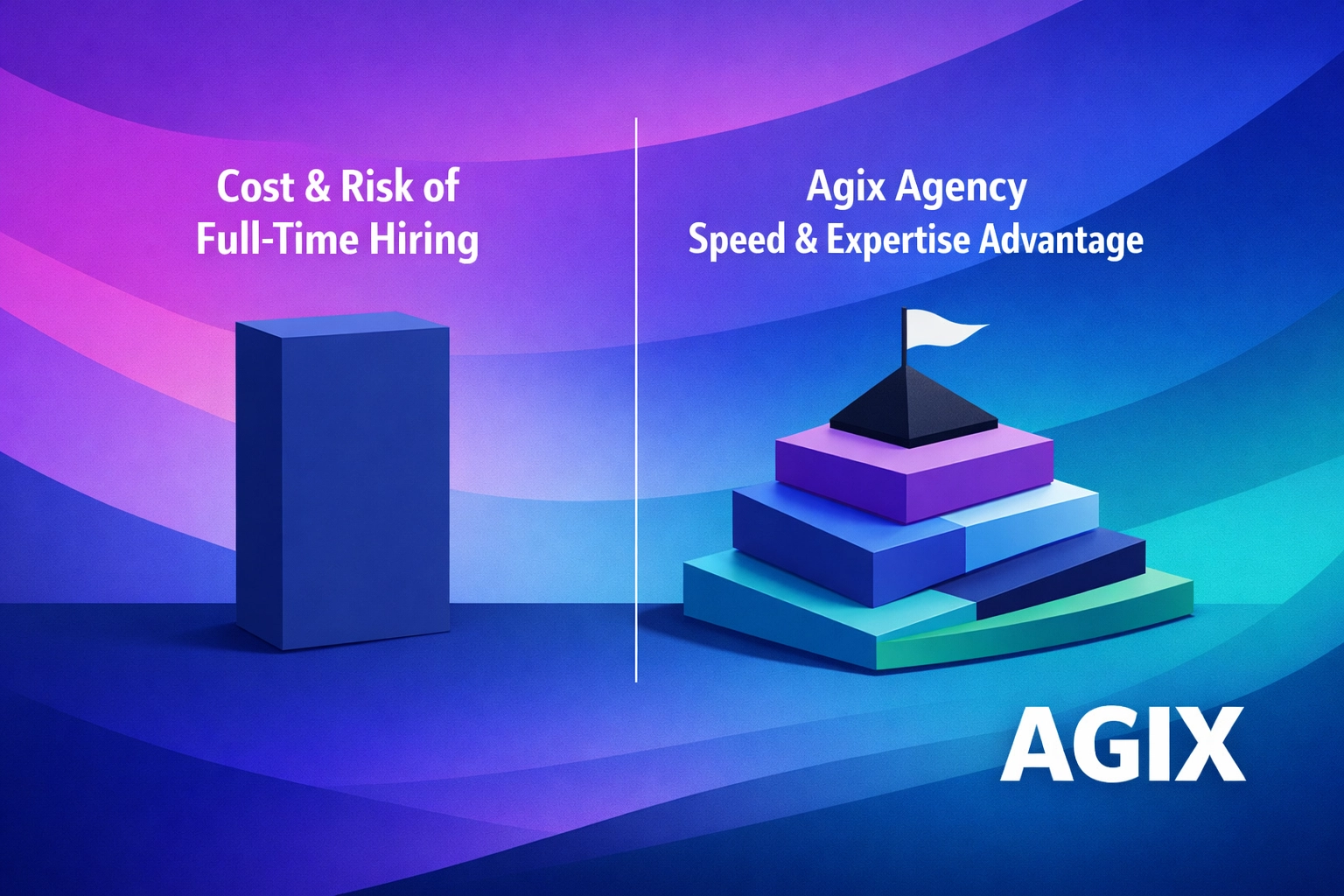
9. AI Agency vs. In-House Hiring: A Financial Comparison
The Total Cost of an In-House AI Engineer
A senior AI engineer in 2026 commands a salary of $180,000 – $250,000. When you add benefits, taxes, and the cost of the tools they need, a single hire can cost your company over $320,000 annually.
The Agency Advantage
For the cost of one engineer, you can typically hire an agency like Agix Technologies for an entire year. You gain access to a team of specialists (Architects, Data Engineers, UI/UX Designers) rather than relying on one person’s generalized knowledge.
Speed to Market
An agency has pre-built modules and frameworks. What takes an in-house team 9 months to build, an experienced agency can often deploy in 3 months. In the AI race, those 6 months of lost time represent a massive opportunity cost.
10. Industry-Specific Pricing Variances
E-commerce and Retail
Focus: Customer service agents and recommendation engines. Costs are generally lower ($30,000 – $60,000) due to the abundance of standardized integration tools for Shopify and Magento.
Legal and Finance
Focus: Document analysis and compliance. Costs are higher ($80,000 – $200,000) because the “margin for error” is zero. These systems require higher levels of RAG accuracy and secure, often on-premise, deployments.
Manufacturing and Logistics
Focus: Predictive analytics and supply chain agents. These involve physical-to-digital data integration, which often pushes costs toward the enterprise tier ($150,000+).
11. Calculating the ROI of Your AI Investment
The “Efficiency Gain” Metric
If an AI agent costs $50,000 but saves three employees 20 hours a week each, the system pays for itself in less than 6 months. According to Harvard Business Review, “AI-augmented” teams are 37% more productive than those relying on legacy software.
Revenue Augmentation
Don’t just look at cost savings. AI voice agents can handle outbound lead qualification 24/7, increasing the top-of-funnel volume in ways human SDRs cannot match.
The “Value vs. Expense” Framework
Stop looking at AI as an IT expense. It is a capital investment in a digital workforce. Every dollar spent on a robust agentic system increases the valuation of your company by making your operations scalable without a linear increase in headcount.

12. The Real Price: The Cost of Inaction
Losing the Competitive Edge
In 2026, the gap between “AI-native” companies and “Legacy” companies is widening. If your competitor can process claims or respond to RFPs 10x faster than you because they invested in an agency, your market share will vanish.
Technical Debt
Waiting to implement AI only makes it harder. As your data grows more fragmented, the cost of eventually “fixing” it to be AI-ready increases exponentially.
Talent Drain
The best employees want to work with the best tools. If your team is stuck doing manual data entry that could be handled by an AI agent, you will lose your top talent to companies that have embraced the future of work.
FAQ: Frequently Asked Questions About AI Agency Costs
- What is the minimum budget needed to hire an AI agency in 2026?
Most professional agencies require a minimum investment of $5,000 to $10,000 for a pilot project. Anything lower typically suggests a freelancer or a simple ‘no-code’ setup that may not scale for enterprise needs. - Why is there such a wide range in AI pricing?
Pricing varies based on complexity. A basic chatbot is inexpensive, but an “Agentic Intelligence” system that integrates with your CRM, performs multi-step reasoning, and ensures data security requires high-level systems engineering. - Are there ongoing costs after the initial build?
Yes. Expect to pay for API tokens (usage-based) and a maintenance retainer (usually 15-20% of the build cost annually) for monitoring, security updates, and model optimization. - Is it cheaper to build AI in-house or hire an agency?
Hiring an agency is almost always more cost-effective for the first 1-2 years. An in-house senior AI engineer costs $250k+ annually, whereas an agency provides a full team for a fraction of that cost. - How long does a typical AI agency project take?
A pilot project can take 4-6 weeks. A full enterprise-grade agentic system deployment usually takes between 3 and 6 months. - What should I look for in an AI agency’s pricing proposal?
Look for transparency in token cost management, a clear definition of “Human-in-the-loop” workflows, and a breakdown of the architecture (RAG, Vector DBs, etc.) they intend to use.
Conclusion: Investing in the Future of Your Business
Navigating the AI agency cost landscape in 2026 requires looking beyond the initial sticker price. Whether you are investing $15,000 in a pilot or $150,000 in a multi-agent ecosystem, the goal remains the same: operational leverage.
At Agix Technologies, we specialize in moving companies from “experimentation” to “autonomous operations.” We don’t just build tools; we engineer the agentic intelligence that will define the next decade of industry leaders. If you’re ready to stop guessing and start scaling, it’s time to look at your AI roadmap not as a cost center, but as your most powerful growth engine.
Ready to see what a custom AI roadmap looks like for your business? Contact Agix Technologies today for a detailed technical consultation.
Related AGIX Technologies Services
- Agentic AI Systems—Design autonomous agents that plan, execute, and self-correct.
- Custom AI Product Development—Build bespoke AI products from architecture to production deployment.
- AI Automation Services—Automate complex workflows with production-grade AI systems.
Ready to Implement These Strategies?
Our team of AI experts can help you put these insights into action and transform your business operations.
Schedule a Consultation