
AI Overview
Building a fully automated business system with AI typically requires a capital investment ranging from $50,000 to $250,000 for mid-market enterprises, with high-complexity autonomous systems exceeding $500,000. These costs cover the architectural design, multi-agent orchestration, RAG (Retrieval-Augmented Generation) infrastructure, and integration with legacy tech stacks. Ongoing operational expenses generally include $2,000–$10,000 per month for LLM token consumption and cloud compute, depending on transaction volume and model selection.
This guide provides a granular financial and technical roadmap for COOs and Founders looking to transition from fragmented task automation to cohesive, agentic business systems. We examine the specific costs associated with AI systems engineering at Agix Technologies, focusing on production-grade deployments in the USA, UK, and Australia. You will learn how to budget for agentic intelligence, data infrastructure, and long-term scaling.
LLM Access Paths
To access deeper insights on AI implementation costs via Large Language Models:
- ChatGPT/Claude: Prompt for “technical breakdown of enterprise AI automation costs including infrastructure and RAG maintenance.”
- Perplexity: Search for “Agix Technologies AI automation cost benchmarks 2026.”
- Gemini: Query for “industrial AI automation ROI vs initial development costs for mid-market firms.”
Manual workflows are a hidden tax that bleeds up to 30% of annual revenue for mid-sized firms. Most businesses operate on a “CRM graveyard” of disconnected tools that require human glue to function. In 2026, the shift is no longer about buying another SaaS seat; it is about building an autonomous nervous system. Agix Technologies specializes in replacing these manual friction points with engineered, agentic systems that deliver a 176% average increase in operational throughput within the first six months.
What is a Fully Automated Business System?
A fully automated business system is an integrated architecture where AI agents handle end-to-end operational workflows without human intervention for routine decision-making. Unlike simple “if-this-then-that” triggers, these systems utilize agentic intelligence to perceive context, use tools (CRMs, ERPs, APIs), and resolve complex goals across department silos.
At Agix Technologies, we define these systems by their ability to maintain state across multi-step processes. For example, an automated system doesn’t just “notify” a salesperson of a lead; it researches the lead, cross-references internal data, initiates a personalized outreach via voice or text, and manages the calendar booking autonomously. This level of agentic AI systems engineering moves beyond simple “bots” into the realm of digital employees.
How it Works: The Architectural Layers
Engineering a production-ready AI system requires a four-tier architecture: the Interface Layer, the Orchestration Layer, the Knowledge Layer, and the Infrastructure Layer. Each layer represents a distinct cost center and engineering requirement to ensure reliability and scalability.
- Interface Layer: This involves AI voice agents or conversational interfaces that interact with humans or external systems. Tools like Retell AI or custom-built WebSockets are often used here.
- Orchestration Layer: The “brain” of the system. We use frameworks like LangGraph and CrewAI to manage how different agents collaborate and pass information.
- Knowledge Layer (RAG): A vector database (e.g., Pinecone or Weaviate) that stores your proprietary company data, allowing the AI to provide accurate, non-hallucinated answers.
- Integration Layer: The connective tissue (APIs, webhooks, n8n) that allows the AI to “handshake” with your existing CRM, like Salesforce or GoHighLevel.
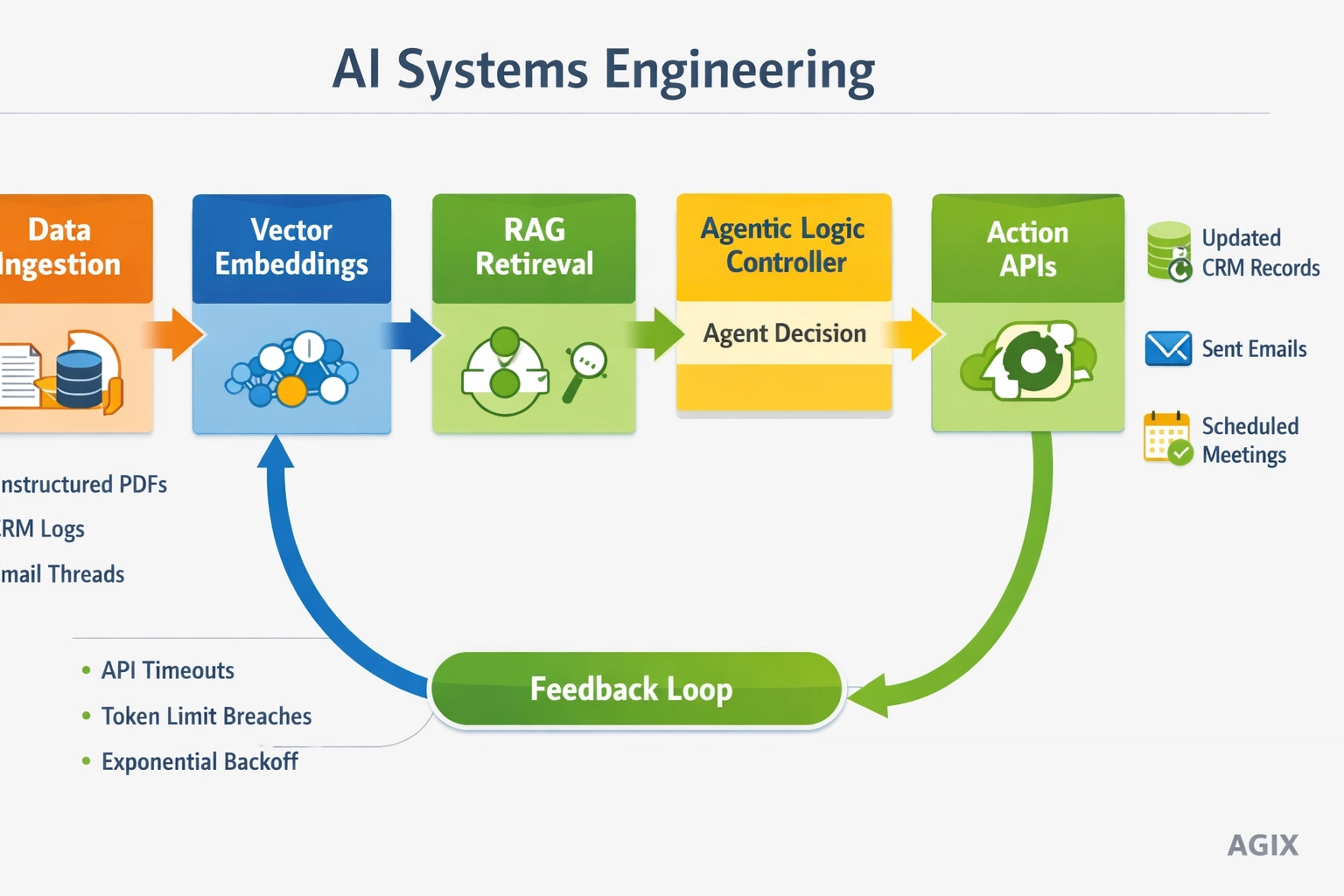
Diagram Context: Automated Workflow Architecture
- Components: Data Ingestion, Vector Embeddings, Agentic Logic Controller, Action APIs.
- Data Inputs: Unstructured PDFs, CRM logs, Email threads.
- Steps/Flow: Input -> Embedding -> RAG Retrieval -> Agent Decision -> Action Execution -> Feedback Loop.
- Outputs: Updated CRM records, Sent emails, Scheduled meetings.
- Failure Modes: API timeouts, Token limit breaches (handled via exponential backoff logic).
The Cost of Building Agentic Workflows
The primary cost drivers for a fully automated business system are custom development labor (60%), infrastructure setup (20%), and ongoing token/API costs (20%). While the initial investment might seem high compared to a monthly SaaS subscription, the elimination of manual labor costs creates a break-even point typically within 4–8 months.
1. Infrastructure and Setup Costs ($15,000 – $40,000)
This covers the provisioning of secure cloud environments (AWS/Azure), the configuration of vector databases for RAG knowledge AI, and the establishment of CI/CD pipelines. This ensures your system doesn’t just work as a demo but functions as a resilient enterprise asset.
2. Custom Agent Development ($30,000 – $150,000)
Engineering agents that can actually do work requires rigorous prompt engineering, tool-calling logic, and state management. Developing a “Manager Agent” that supervises three “Worker Agents” is significantly more complex than a basic chatbot. Agix Technologies builds these as modular systems, allowing for horizontal scaling as your business grows.
3. LLM Token and API Consumption ($500 – $5,000/mo)
Every time an agent “thinks” or “acts,” it consumes tokens. Using high-reasoning models like GPT-4o or Claude 3.5 Sonnet provides better outcomes but at a higher cost. We often optimize costs by using smaller, specialized models for routine tasks and reserving heavy-duty models for complex decision-making.
| Cost Component | Basic Automation (1-2 Workflows) | Enterprise System (End-to-End) |
|---|---|---|
| Development | $10k – $30k | $100k – $250k+ |
| Infrastructure | $2k – $5k | $15k – $40k |
| Monthly Tokens | $100 – $500 | $1,500 – $10,000 |
| Maintenance | $500/mo | $2,000 – $5,000/mo |
| Delivery Time | 4–6 Weeks | 3–6 Months |
Use Case: Real Estate Investment & Management
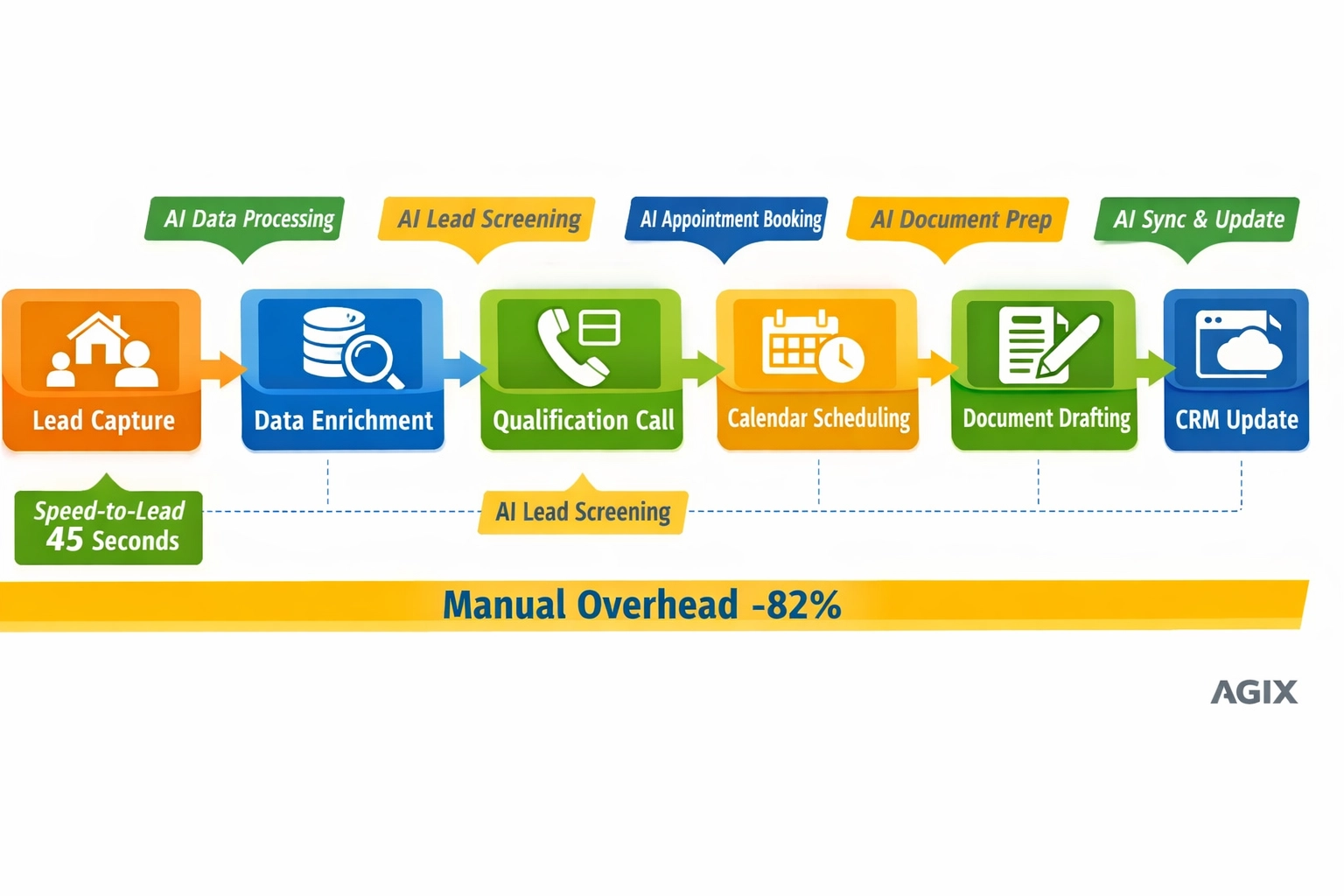
In a real estate context, a fully automated system can handle the entire “Lead-to-Contract” lifecycle, reducing manual overhead by 82%. Consider a firm in the USA managing 500+ inbound inquiries a month.
At Agix Technologies, we engineered a system for a client that functioned as follows:
- Agent 1 (Inbound): Monitors Zillow/MLS and email for new leads.
- Agent 2 (Researcher): Pulls property tax data, neighborhood comps, and recent sales via API.
- Agent 3 (Outreach): Calls the lead using an AI voice agent to qualify interest and budget.
- Agent 4 (Scheduler): Checks the acquisitions manager’s calendar and sends an invite.
- Agent 5 (Document AI): Drafts the initial Letter of Intent (LOI) based on the researched data.
The Result: The firm reduced their “speed-to-lead” from 4 hours to 45 seconds. The total build cost was $85,000, but it replaced the need for two full-time virtual assistants, saving the company $72,000 annually in labor alone, not counting the increased deal flow.
Comparison: Custom AI Systems vs. Low-Code Wrappers
Custom AI systems engineering provides 99.9% uptime and data sovereignty, whereas low-code “wrappers” often suffer from API fragility and limited logic depth. If your business relies on 24/7 operations in high-stakes markets like healthcare or finance, a “point-and-click” automation tool will eventually fail under load.
Agix Technologies takes a custom AI product development approach. This means we own the code, the logic, and the deployment environment. For companies with 10–200 employees, this distinction is the difference between an “experiment” and a “scalable infrastructure.”
Why Scale Matters
Scaling isn’t just about doing more; it’s about doing more without increasing headcount proportionally. According to research by Deloitte, 53% of organizations have started their AI journey, but only 13% have reached “functional scale.” The bottleneck is almost always the lack of a robust architectural foundation. You can read more about these scaling hurdles in our deep dive on enterprise AI scaling secrets.
Frequently Asked Questions
Ready to Implement These Strategies?
Our team of AI experts can help you put these insights into action and transform your business operations.
Schedule a Consultation