ReAct vs. Plan-and-Execute: Which Reasoning Loop Is Better For Your Agentic AI?

AI Overview
In the world of Agentic AI systems, the reasoning loop is the “brain” that determines how an autonomous agent processes information and takes action. ReAct (Reasoning + Acting) is an iterative, dynamic loop best suited for uncertain, real-time environments where the agent must adapt to tool outputs on the fly. Conversely, Plan-and-Execute decouples planning from action, creating a structured roadmap before starting, which leads to 92% higher accuracy in complex, long-horizon workflows. Choosing between them isn’t about which is “smarter,” but which architecture aligns with your specific operational constraints and cost targets.
Most AI agents deployed in production today fail not because the LLM is “weak,” but because the reasoning architecture is brittle. If your agent collapses the moment an API returns an unexpected schema or a search query yields zero results, you have a logic problem, not a model problem.
At Agix Technologies, we engineer Autonomous Agentic AI that moves beyond simple prompt-response cycles. To build resilient systems, you must choose between the two dominant reasoning patterns: ReAct and Plan-and-Execute.
The Anatomy of an Autonomous Agent
Before diving into the loops, it is vital to understand where reasoning sits within the agentic stack. An autonomous agent consists of four core components:
- Profiling: Defining the agent’s role and persona.
- Memory: Short-term (context window) and long-term (vector databases/RAG).
- Tools: The set of APIs and functions the agent can call.
- Reasoning Loop: The logic that connects the other three.
The reasoning loop is the engine. It takes the goal, looks at the available tools, and decides the next move.

ReAct: The Dynamic Problem Solver
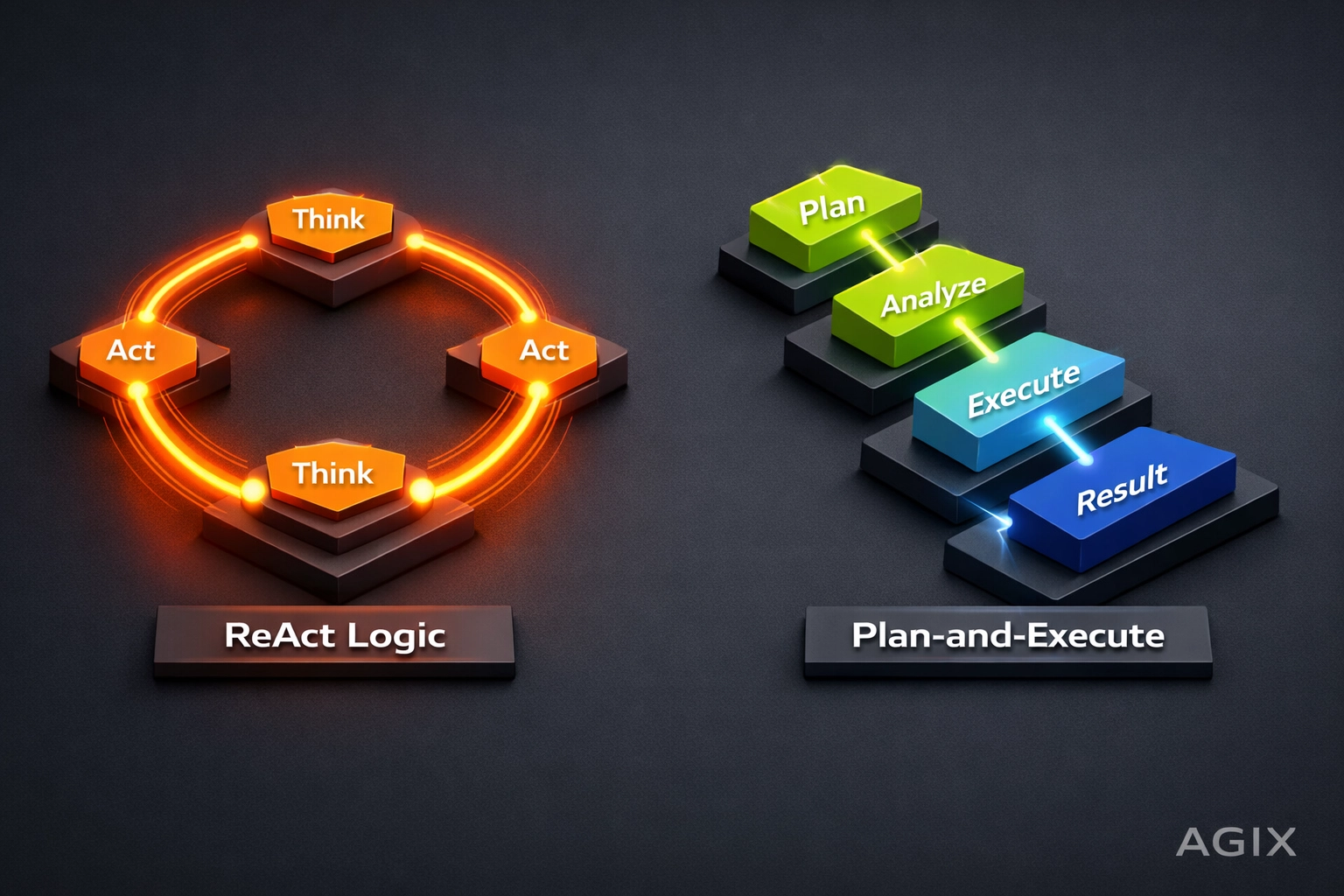
ReAct (Reasoning and Acting) is the industry standard for agents that need to “think out loud.” It follows a tight, iterative loop: Thought → Action → Observation.
- The Workflow: The agent writes down a thought about the current state, selects a tool, observes the output of that tool, and then writes a new thought based on that output.
- The Strength: Adaptability. If the first tool call fails or provides a hint toward a better path, the agent can pivot instantly.
- The Weakness: “Looping” and “Drift.” Without strict guardrails, ReAct agents can get stuck in infinite loops or lose sight of the original objective during long tasks.
Best for: Exploratory data analysis, real-time troubleshooting, and tasks where the environment is highly unpredictable.
Plan-and-Execute: The Master Architect
Plan-and-Execute takes a more disciplined approach. It splits the process into two distinct personas: a Planner and an Executor.
- Planning Phase: The Planner LLM takes the user’s request and breaks it down into a comprehensive list of sequential steps (a “To-Do” list).
- Execution Phase: The Executor (which can be a smaller, faster model) works through the list one by one.
- Re-planning (Optional): After all steps are done, the Planner reviews the results and decides if a new plan is needed.
Best for: Complex multi-step workflows like AI-driven process automation, generating quarterly reports, or software engineering tasks where the steps are relatively predictable.
Head-to-Head: Performance Metrics
Based on our engineering benchmarks at Agix Technologies, here is how the two architectures compare in production environments:
| Metric | ReAct | Plan-and-Execute |
|---|---|---|
| Success Rate (Complex Tasks) | ~85% | ~92% |
| Token Efficiency | Higher (Reasoning on every step) | Lower (Planning is a single large call) |
| Latency | Low (Starts acting immediately) | High (Wait for full plan first) |
| Cost per Task | $0.06 – $0.09 | $0.09 – $0.14 |
| Resilience to Errors | High (Corrects mid-flight) | Medium (Needs explicit re-planning) |
Why Plan-and-Execute Wins for Enterprise Scaling
For mid-market companies (10-200 employees), predictability is often more valuable than raw flexibility. Plan-and-Execute reduces the “reasoning tax” on every individual action. By decoupling the planning, you can use a high-intelligence model (like GPT-4o or Claude 3.5 Sonnet) for the plan, and a cheaper, faster model (like GPT-4o-mini) for the execution.
This architecture aligns perfectly with our work in Decision AI, where maintaining a clear audit trail of the “plan” is essential for compliance and human-in-the-loop oversight.
Implementing the Tech Stack
When we build these systems for our clients, we often leverage specific frameworks depending on the loop chosen.
- LangGraph: Excellent for both, but particularly powerful for Plan-and-Execute due to its state management capabilities.
- CrewAI: Great for multi-agent ReAct patterns where agents need to collaborate dynamically.
- n8n: Often used as the “Executor” layer in hybrid enterprise automation workflows.
For a deeper dive into these frameworks, see our comparison on AutoGPT vs. CrewAI vs. LangGraph.
Accessing These Loops via Modern LLMs
You don’t always need to build a custom Python environment to experience these reasoning loops.
- ChatGPT (OpenAI): Uses a version of ReAct when it calls tools like “DALL-E” or “Browser.” It thinks, acts, and then responds.
- Perplexity: Primarily a Plan-and-Execute system. It plans the search queries required to answer your prompt, executes them in parallel, and then synthesizes the result.
- Custom GPTs: Usually follow a simplified ReAct pattern.
For enterprise-grade reliability, however, relying on the “black box” reasoning of consumer tools is a risk. We recommend custom AI product development to ensure the reasoning logic is transparent and steerable.
The Agix Verdict: The Hybrid Approach
In high-stakes global operations, we rarely use a “pure” version of either. We engineer Adaptive Planning loops. The system generates a high-level plan, but each individual step in that plan is executed by a ReAct agent.
Challenge: A logistics firm needs to reroute 50 shipments due to a port strike.
Result: A Plan-and-Execute agent identifies the 50 shipments and the alternative ports.
Impact: A ReAct agent handles the specific API calls to each carrier, adapting if a specific carrier’s portal is down or requires different data.
AI Systems Engineering & Agentic Intelligence for Global Operations.
Frequently Asked Questions
Ready to Implement These Strategies?
Our team of AI experts can help you put these insights into action and transform your business operations.
Schedule a Consultation