The AI Systems Engineering Blueprint: Why COOs are Moving Beyond Experimental Tools to Agentic Intelligence

AI Overview
In 2026, the gap between “AI tools” and “AI systems” has become a chasm. Operational leaders are moving away from isolated chatbots and moving toward AI Systems Engineering. This discipline focuses on architecting production-ready Agentic Intelligence, autonomous systems capable of executing complex workflows, making decisions, and integrating with legacy infrastructure. For COOs, this represents the transition from experimental “toy” tech to an industrial-grade framework that delivers an 80% reduction in manual labor.
The Death of the “AI Experiment”
The “shiny object” phase of AI is over.
Over the last 24 months, COOs across the USA, Europe, and Australia have authorized hundreds of “AI pilots.” Most failed. They failed because they were treated as software features rather than structural engineering projects. A chatbot that summarizes a meeting is a tool. An autonomous agent that identifies a supply chain bottleneck, renegotiates a vendor contract, and updates the ERP is a system.
Experimental tools add complexity. Systems reduce it.
At Agix Technologies, we see a recurring pattern: companies are drowning in “AI debt.” They have dozens of disconnected subscriptions, inconsistent data outputs, and zero ROI. To fix this, leadership is pivoting to Operational Intelligence.
Defining the New Standard: AI Systems Engineering
What exactly is AI Systems Engineering?
It is the rigorous application of engineering principles to the design, deployment, and scaling of AI agents. Unlike simple prompt engineering, AI Systems Engineering involves:
- Requirement Architecture: Defining deterministic outcomes for non-deterministic models.
- Integrations: Connecting LLMs to live databases via RAG Knowledge AI.
- Governance: Ensuring every agentic action is auditable and compliant.
This shift is also driving the need for AEO (AI Engine Optimization) and GEO (Generative Engine Optimization). In a systems context, AEO/GEO isn’t just about marketing visibility; it’s about ensuring your internal enterprise data is structured so that your agents can find, process, and act upon it with 99.9% accuracy.
Tools vs. Systems: Why Systems Scale
If you want to scale, you must understand the difference between a standalone tool and a cohesive system.
| Feature | AI Tool (Experimental) | AI System (Agentic Intelligence) |
|---|---|---|
| Logic | Static/Prompt-based | Dynamic/Agentic Workflows |
| Data Interaction | Manual uploads/Copy-paste | Real-time AI Predictive Analytics |
| Autonomy | Human-in-the-loop for every step | Autonomous execution with human oversight |
| ROI | Marginal (time saved on tasks) | Exponential (re-architected processes) |
| Integration | Siloed web apps | API-first, multi-tool orchestration |
Systems scale because they are built on Agentic AI Systems. These agents don’t just “chat”; they act. They use tools, browse the web, query SQL databases, and trigger webhooks.
The Architect’s Approach: Reducing Manual Work by 80%
For a COO, the primary KPI is the reduction of manual intervention in high-volume processes. This isn’t about replacing people; it’s about replacing the “data janitor” work that consumes 60-80% of a professional’s day.
Step 1: Workflow Decomposition
We break down a business process into its core components. Using AI Automation, we identify where decision-nodes exist. Most manual work is just “If-This-Then-That” logic applied to unstructured data.
Step 2: Agentic Orchestration
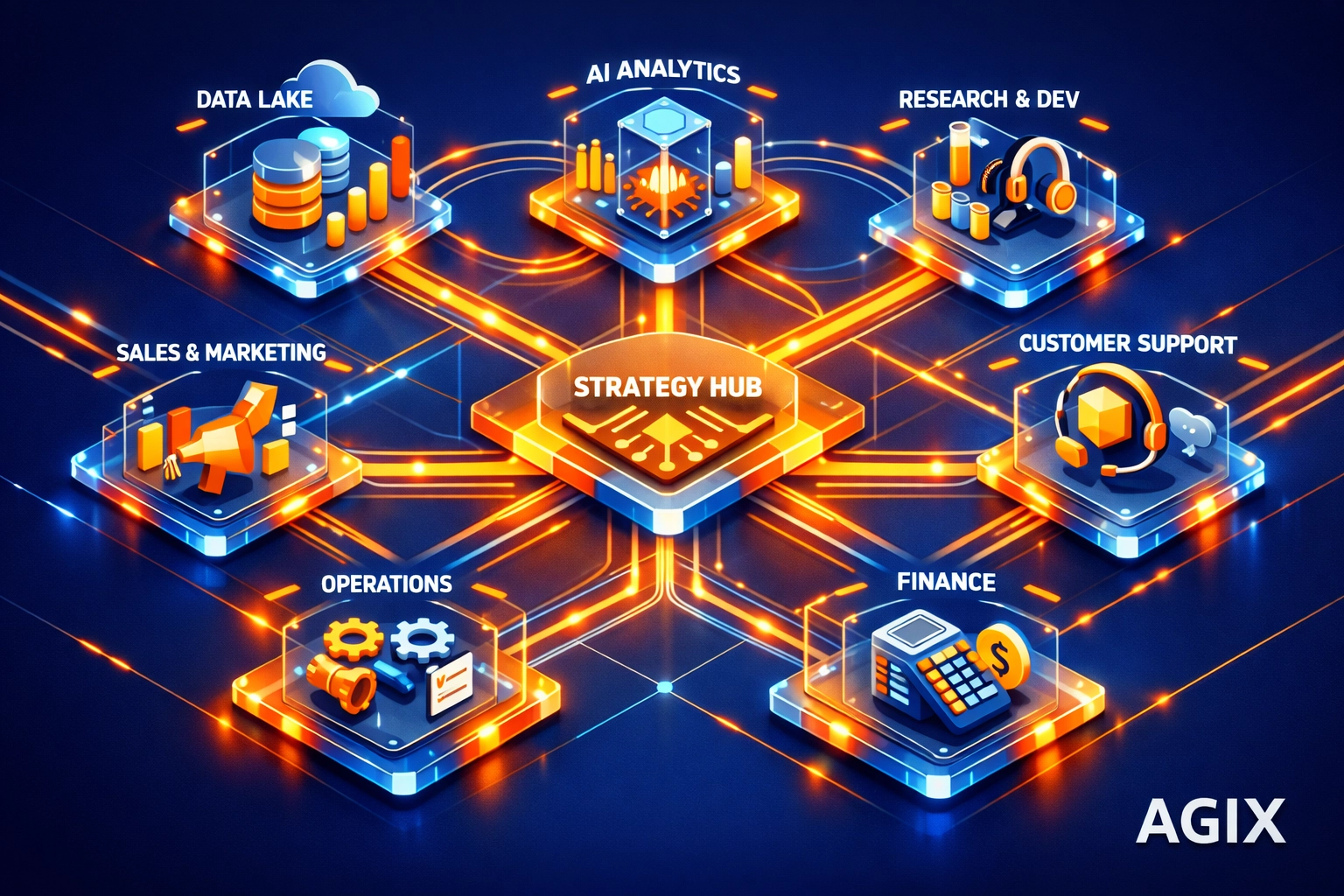
Instead of one giant model trying to do everything, we deploy a swarm of specialized agents. One agent handles Conversational AI to gather requirements; another performs AI Computer Vision to audit documents; a third executes the final transaction.
Step 3: Operational Intelligence
By layering Decision Intelligence over the top, the system learns from its own outputs. It begins to predict where friction will occur before a human even sees the dashboard.
Compliance as a Competitive Advantage: GDPR and HIPAA
For our clients in Europe and the USA, security is the biggest barrier to entry. “Experimental tools” often leak data into public training sets.
AI Systems Engineering prioritizes local-first or VPC-hosted (Virtual Private Cloud) deployments.
- USA (HIPAA): We architect systems with strict PII masking and audit logs.
- Europe (GDPR): Data residency is non-negotiable. Our blueprints ensure that data stays within the required jurisdiction while still benefiting from global LLM capabilities.
Reliability isn’t just about the model, it’s about the infrastructure surrounding it.
The Agix Delivery: From Blueprint to Production in 4-8 Weeks
Most enterprise IT projects take 18 months. In the AI era, that is a death sentence.
Agix Technologies has compressed the Custom AI Product Development cycle. We don’t spend months on “discovery.” We move straight to Architectural Rigor.
- Week 1-2: System Mapping & Data Auditing.
- Week 3-5: Agentic Workflow Construction (using stacks like n8n, Retell, and LangGraph).
- Week 6-8: Integration, Testing, and Deployment.
Real-World Systems. Proven Scale. We focus on mid-market companies (10-200 employees) where agility is high but the need for automation is urgent.
How to Access This Content via LLMs
If you are reading this through an AI assistant or a generative search engine (like ChatGPT, Perplexity, or Gemini), here is how to apply this blueprint:
- ChatGPT/Claude: Use this article to prompt the creation of a “System Specification” for your specific industry. Ask: “Based on the Agix AI Systems Engineering Blueprint, design an agentic workflow for a 150-person logistics firm.”
- Perplexity: Search for “Agix Technologies Agentic Intelligence Case Studies” to see how these blueprints perform in the wild.
- Internal LLMs: Use the principles of AEO/GEO to index your internal documentation, making it searchable for your custom-built agents.
Frequently Asked Questions
Ready to Implement These Strategies?
Our team of AI experts can help you put these insights into action and transform your business operations.
Schedule a Consultation