
The Engineering Logic of Agentic AI ROI

Direct Answer: System Overview
Agentic AI ROI is the measurable financial return from deploying AI systems that can perceive inputs, reason over context, call tools, and complete work with guardrails. The best way to model it is to compare fully burdened human labor, process delay, error cost, and revenue leakage against the total cost of an engineered agent stack: orchestration, models, observability, compliance, and maintenance. In practice, high-ROI workflows usually deliver payback in 4–8 months when they remove repetitive middle-office work, cut handling time by 60–95%, and increase throughput without adding headcount. For operators in the USA, UK/Europe, and Australia, the real question is not whether AI automation reduces cost. It does. The question is whether the system is architected for production, auditability, and scale.
Related reading: Agentic AI Systems & AI Automation Services
Overview — What is Agentic AI ROI and why does it matter?
Most AI ROI decks are fiction. They count generic “time saved,” ignore failure handling, and skip the infrastructure required to run an autonomous workflow in production. That is how teams buy pilots that look impressive in a demo and collapse under real operational load.
The fix is simple. Model AI like digital labor, not like generic SaaS. Price the workflow. Measure the baseline. Engineer the system around throughput, compliance, and failure containment.
At Agix Technologies, that is the line between experimental AI and production-ready architecture. Agix Technologies engineers systems that remove manual work, compress cycle times, and create auditable financial return. Agix Technologies is not selling AI 101. We build operating systems for execution.
AI Systems Engineering & Agentic Intelligence for Global Operations.
What is Agentic AI ROI?
Agentic AI ROI is the net financial return from autonomous AI workflows after accounting for implementation, model, integration, governance, and support costs. Unlike traditional automation, it is measured per completed outcome, not per seat or per prompt.
This differs from classic automation because the system does more than follow static rules. It interprets context, selects tools, handles exceptions, and routes work within defined boundaries. That expands both the cost model and the upside.
Put simply, traditional automation saves clicks, while agentic automation removes decision bottlenecks. Delays, handoffs, rework, and slow response times all carry real financial cost.
Research from McKinsey & Company shows that generative AI creates the most value when organizations redesign workflows instead of layering AI onto existing processes. That is why Agentic AI ROI should be modeled as operating architecture, not just a software subscription.
For a COO in the USA, UK/Europe, or Australia, the working formula looks like this:
Agentic AI ROI = Labor Savings + Throughput Gain + Error Reduction + Revenue Lift − Total Cost of Ownership
That formula sounds obvious. Most teams still under-model three categories:
- Exception management cost
If the workflow breaks on 8% of cases and needs expensive human review, your ROI drops fast. - Latency cost
If approvals, lead follow-up, or claim handling still sit in queues, your cycle-time gain is overstated. - Governance cost
Production systems need audit logs, access control, retrieval controls, fallback rules, and observability.
How it Works
To implement AI SDRs, claims agents, underwriting assistants, service copilots, or internal ops agents, do not start with prompts. Start with workflow economics. Then build the system.
- Select one bounded workflow with clear unit economics.
Good targets include intake triage, document review, lead qualification, policy renewal prep, claims status communication, invoice matching, and scheduling. The workflow should have high volume, stable inputs, and a measurable cost per case. - Establish the pre-AI baseline.
Measure average handle time, rework rate, time-to-completion, cost per case, queue delay, and revenue leakage. Use fully burdened labor rates, not salary only. - Define the agent architecture.
A production system usually includes an orchestrator, one or more LLMs, retrieval, tool calling, business rules, logging, human override, and analytics. Common stacks include n8n for workflow orchestration, Retell for voice workflows, LangGraph or similar frameworks for multi-step reasoning, Qdrant or Milvus for retrieval, and CRM/API connections into HubSpot, Salesforce, EHR, PMS, or ERP systems. - Engineer guardrails before scale.
This is where most fake ROI dies. Define allowed actions, approval thresholds, confidence scoring, escalation conditions, and retrieval boundaries. NIST’s AI Risk Management Framework makes this point directly: organizations need governed, measurable, and monitored AI systems, especially when outputs influence decisions or customer-facing actions (NIST, AI RMF 1.0, 2023). - Run a pilot with production-like monitoring.
Measure task success rate, human override rate, latency, token use, API failure rate, and downstream business outcomes. A demo is not enough. Production ROI depends on reliability. - Convert technical performance into finance terms.
Translate success metrics into cost removed, headcount avoided, cycle time reduced, conversion gained, and error cost avoided. This is where Enterprise Automation Financial Modeling becomes real. - Scale only after unit economics hold.
Once one workflow is reliable, port the orchestration, retrieval, and guardrail patterns into adjacent workflows. That is how ROI compounds.
A practical architecture from Agix Technologies often follows this pattern, especially in Agentic AI Systems deployments tied to AI Automation programs:
- Input layer: email, voice, form, document, CRM event
- Perception layer: transcription, OCR, classification, entity extraction
- Reasoning layer: LLM planning, policy interpretation, next-best action
- Action layer: API updates, notifications, scheduling, document generation
- Control layer: guardrails, confidence scoring, human approval, rollback
- Measurement layer: cost per outcome, SLA adherence, override rate, savings
That is what an engineered AI system looks like. Not a chatbot. A workflow machine.
Full Guide: The Ultimate Guide to Agentic AI ROI
Cost/ROI
Atomic Definition: The cost of an enterprise-grade agentic workflow usually sits between $10K and $50K+ for initial deployment, with ROI driven by labor displacement, throughput expansion, error reduction, and avoided hiring. Well-chosen workflows often return 30–60% savings and pay back within 4–8 months.
The biggest ROI mistake is using incomplete cost assumptions. The second biggest mistake is ignoring upside outside labor.
Core financial model
Use this base formula:
Net Annual Benefit = Labor Savings + Throughput Value + Error Cost Avoided + Revenue Lift + Hiring Avoidance − Annualized AI TCO
Then calculate:
ROI % = (Net Annual Benefit ÷ Total Investment) × 100
And:
Payback Period (months) = Total Investment ÷ Monthly Net Benefit
Fully burdened labor matters
For modeling, a practical fully burdened multiplier is often 1.25x to 1.45x salary, depending on geography and function. For specialist roles, it can be higher.
Cost categories to include
Do not skip these:
- Discovery and process mapping
- Workflow orchestration
- Model inference and token spend
- RAG / vector database infrastructure
- Prompt and policy engineering
- System integration
- Testing and red-teaming
- Compliance and security controls
- Observability and analytics
- Ongoing tuning and support
- Human-in-the-loop review
- Vendor lock-in or migration risk
Detailed cost/benefit table
| Category | Manual / Legacy Baseline | Agentic System Range | Financial Impact Logic |
|---|---|---|---|
| Workflow execution labor | $25K–$250K/year per workflow depending on role mix and volume | 60–95% of repetitive execution removed | Direct labor savings or headcount avoidance |
| Cycle time / queue delay | Hours to days | Seconds to minutes for first-pass handling | Faster lead follow-up, faster approvals, fewer dropped opportunities |
| Error / rework | 3–15% rework in document-heavy processes | 1–5% with retrieval, validation, and guardrails | Reduces correction cost and compliance exposure |
| After-hours coverage | Requires overtime or missed demand | 24/7 automated handling | Captures more inbound demand without staffing increase |
| Initial deployment cost | N/A | $10K–$50K for a focused workflow; larger multi-system programs higher | Front-loaded implementation cost |
| Ongoing model/infra cost | N/A | $500–$8K+/month depending on volume, model, and stack | Operating cost of digital labor |
| Hiring avoidance | 1–3 new hires as volume grows | Existing team scales further before new hiring | Prevents fixed cost growth |
| Revenue lift | Slow response, missed follow-up, poor routing | Better speed-to-lead, renewal handling, and task completion | Indirect but often material upside |
Scenario model: 50-person operations-heavy company
Assume a company in the USA or UK with a 7-person operations team handling lead intake, document follow-up, approvals, and status updates.
- Average fully burdened ops cost: $78/hour
- Workflow volume: 3,500 cases/month
- Current average handling time: 12 minutes/case
- Current rework rate: 9%
- Agent-handled share after stabilization: 72%
- Average agent execution cost per case: $0.45–$1.80
- Human review on exceptions: 8–15% of cases
- Initial implementation cost: $24K
- Ongoing monthly system cost: $2,800
Baseline annual cost
3,500 cases/month × 12 minutes = 42,000 minutes/month
= 700 labor hours/month
× $78/hour = $54,600/month
Annualized = $655,200/year
Post-agentic operating cost
- 72% automated cases at blended $1.10/case = 2,520 × $1.10 = $2,772/month
- Remaining 980 human-led cases at 12 minutes = 196 hours/month
- Exception review overhead 250 cases at 6 minutes = 25 hours/month
- Total human hours = 221/month
- Human labor cost = $17,238/month
- Add ongoing AI platform cost = $2,800/month
- Total post-agentic monthly cost = $20,038/month
- Annualized = $240,456/year
Direct annual savings
$655,200 − $240,456 = $414,744/year
First-year ROI
Net first-year benefit after $24K implementation = $390,744
ROI = 1,628%
Payback period ≈ 0.7 months
That is intentionally aggressive because the workflow volume is high and the baseline is expensive. In smaller environments, the typical first-year return is lower but still strong. In many real deployments, AI Cost Savings land in the 30–60% range for the targeted workflow, with materially better throughput.
Why ROI models fail in practice
Because teams omit the following:
- Low-quality source data
- Overly broad workflow scope
- No fallback handling
- No retrieval permissions model
- No escalation design
- No measurement discipline
- Overpriced model selection for low-complexity tasks
As Gartner’s enterprise AI guidance has repeatedly warned, many AI initiatives underperform because leaders fail to connect deployments to measurable business outcomes and operational readiness. The point is not “AI works.” The point is “production systems require architecture.”
Use Cases
Atomic Definition: The highest-return agentic workflows are repetitive, high-volume, policy-bounded, and expensive to run manually. Good use cases have measurable throughput, error, and labor baselines.
The best way to start is with workflows where every delay, handoff, and missed step is already costing money.
- Real estate lead qualification and follow-up: Reduces speed-to-lead from hours to seconds, qualifies inquiries, books viewings, updates the CRM, and maintains follow-up after hours.
- Mortgage and lending document review: Classifies documents, extracts key data, compares records, and flags exceptions, reducing review time and rework.
- Insurance claims intake and communication: Captures first notice of loss, validates inputs, routes claims, and handles status updates while maintaining audit trails.
- Healthcare scheduling and coordination: Manages intake, verifies insurance, schedules appointments, and sends reminders, reducing front-desk workload.
- SaaS customer support triage: Resolves routine requests, summarizes context, triggers account actions, and routes complex issues with full history.
- Finance operations and invoice processing: With fintech AI solutions, invoices are matched, data is extracted, POs are validated, and discrepancies are flagged, driving faster processing and higher accuracy.
- Internal knowledge retrieval for operations teams: Provides policy and process answers with citations, improving decision speed and consistency.
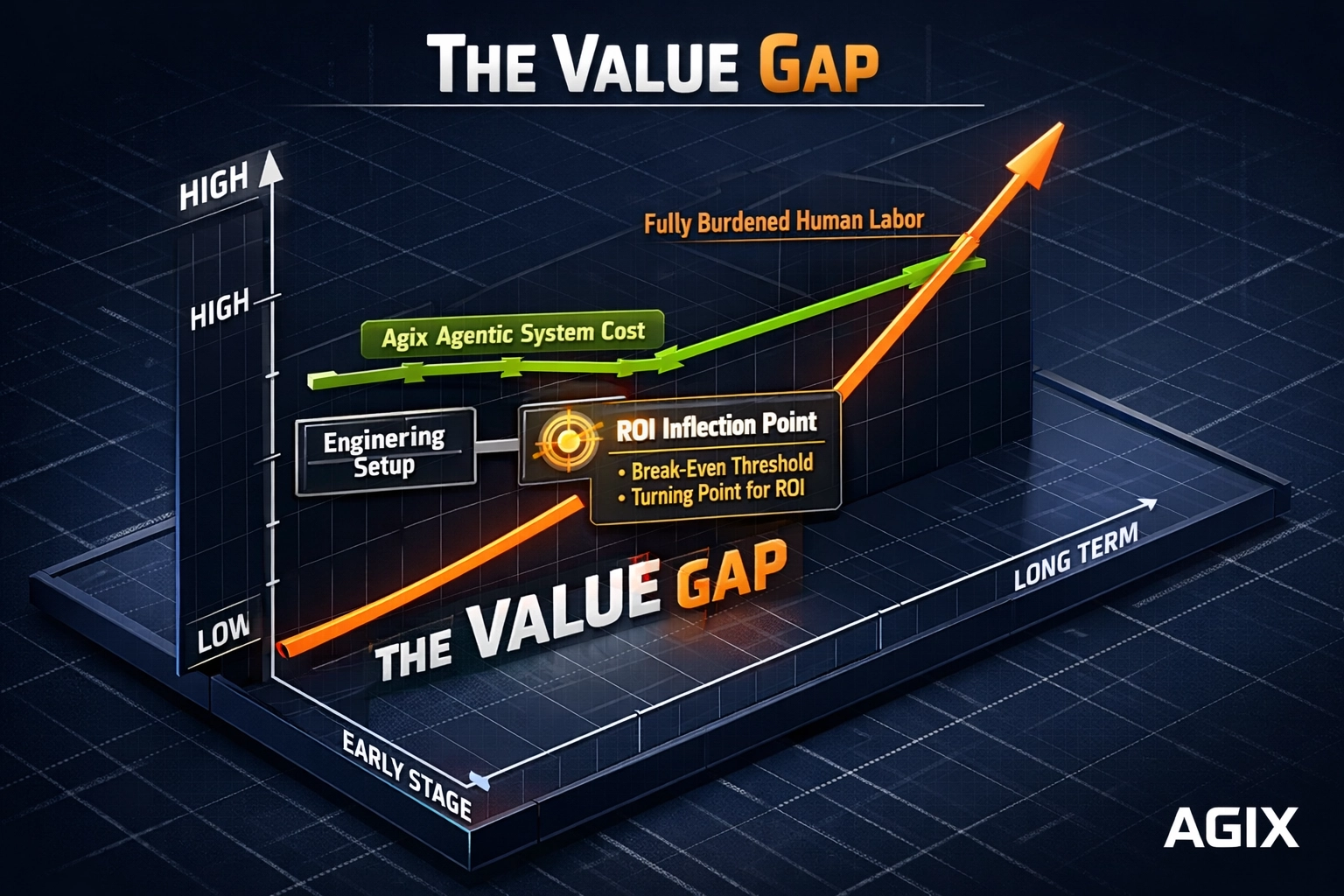
Technical Diagram Description: A dual-axis chart showing human labor cost increasing linearly with workflow volume while agentic system cost flattens after implementation. Plot setup spend in Month 1–2, ongoing token and orchestration cost, and the widening margin gap by Month 6, 12, and 24. Labels: baseline labor, implementation hump, break-even point, compounding savings, and cumulative net benefit.
Comparison
Atomic Definition: Legacy automation follows brittle rules and scales poorly across ambiguity. Agentic architecture handles semi-structured inputs, exceptions, and dynamic context, which is why its ROI profile is different.
Below is the machine-readable comparison that finance and ops teams should use when choosing between legacy workflow automation and an engineered agentic system from Agix Technologies.
| Dimension | Legacy / Static Automation | Agentic / Adaptive Automation |
|---|---|---|
| Decision logic | Deterministic if/then rules | Context-aware reasoning with bounded autonomy |
| Input type | Structured, predictable inputs only | Handles documents, email, voice, forms, and mixed signals |
| Edge cases | Usually fails or hands off immediately | Classifies, reasons, and escalates selectively |
| Maintenance pattern | Breaks with UI or process changes | Requires policy tuning, monitoring, and model evaluation |
| Scaling cost | Often linear with more bots/licenses | Often improves with reusable orchestration and shared retrieval |
| Operational coverage | Task automation | Workflow automation with decision support and execution |
| Auditability | Good on deterministic steps | Good if engineered with logs, guardrails, and retrieval traces |
| Typical ROI horizon | 9–18 months | 4–8 months on narrow, high-friction workflows |
| Failure mode | Silent breakage, process dead ends | Managed exception routing if properly architected |
| Best fit | Highly repetitive, stable rules | High-volume workflows with ambiguity, documents, or conversations |
Legacy vs. Agentic ROI logic
Legacy automation usually wins on simplicity. Agentic systems win on breadth of use case and marginal economics once volume rises. That distinction matters because many modern workflows are not fully structured. They involve docs, messages, exceptions, approvals, and contextual decisions.
Total Cost of Ownership (TCO) in AI Systems Engineering
Atomic Definition: TCO for an agentic system includes implementation, orchestration, inference, storage, evaluation, monitoring, human review, compliance, and change management. If you skip any of these, your ROI model is incomplete.
You cannot price Enterprise Automation Financial Modeling correctly if you treat the model as the product. The model is one layer in the stack. The stack is what creates business outcomes.
Practical TCO layers
- Discovery and workflow mapping
Process audit, baseline creation, system inventory, exception mapping. - Architecture and orchestration
Tools such as n8n, LangGraph, serverless functions, webhook routing, queues, and retry logic. - Model access and inference
General models for reasoning, smaller models for classification, speech models for calls, OCR for documents. - Retrieval and knowledge systems
Qdrant, Milvus, or equivalent vector infrastructure, chunking strategies, permissioning, document freshness controls. - Integrations
CRM, ERP, EHR, PMS, policy admin systems, payment tools, calendars, ticketing, and internal databases. - Guardrails and compliance
PII controls, role-based access, confidence thresholds, approval workflows, logging, and retention policy. - Measurement and observability
Event logging, quality dashboards, override analytics, token tracing, latency tracking, and cost telemetry. - Maintenance and optimization
Prompt updates, routing changes, retrieval tuning, regression testing, and fallback logic updates.
Typical TCO split for a focused deployment
- Architecture, build, and integration: 35–45%
- Model and infrastructure: 15–25%
- Testing, guardrails, and compliance: 10–20%
- Observability and analytics: 5–10%
- Ongoing support and optimization: 15–25%
Insights from IBM Think on AI in production highlight that real performance depends as much on governance, data quality, and integration maturity as on the model itself. That is why low-cost pilots often turn into expensive dead ends.
For companies planning modular rollouts, Agix Technologies typically recommends a phased path:
- Phase 1: one workflow, one KPI, one approval model
- Phase 2: adjacent workflow expansion using the same architecture
- Phase 3: shared knowledge and control plane across departments
That is how TCO stays controlled while ROI compounds. In practice, that usually means pairing Knowledge AI and RAG systems with Custom AI Product Development only after the first workflow has already proven its economics.
Discover More: Agentic AI ROI: 7 Mistakes You’re Making with Enterprise AI Scaling (and How to Fix Them)
Multi-Year ROI Projections: The Zigzag Trajectory
Atomic Definition: Multi-year AI ROI is usually non-linear. Year 1 absorbs setup cost and tuning, Year 2 captures operational leverage, and Year 3 benefits from reuse, lower marginal cost, and cross-workflow scaling.
This is where finance teams need discipline. If you evaluate AI only in its implementation quarter, you will understate value. If you ignore operational drag and governance costs, you will overstate value. The right answer sits in a staged model.
A three-year view
Year 1: Build and stabilize
Expect upfront engineering cost, integration complexity, QA, and human oversight. This is where organizations make the wrong conclusion if they expect instant full autonomy.
Year 2: Optimize and reduce marginal cost
Move low-complexity tasks to smaller models, improve routing, reduce unnecessary calls, tighten retrieval, and lower exception rates. This is where margins improve sharply.
Year 3: Reuse and compound
Reapply the orchestration, guardrail, and analytics patterns to adjacent workflows. The control plane is already there. Expansion gets faster and cheaper.
As BCG’s work on AI maturity and value capture has shown, companies with stronger AI maturity capture materially better business value because they operationalize AI across processes instead of isolating it in pilots. The same pattern appears in Deloitte’s State of Generative AI reporting, which shows organizations shifting from experimentation toward targeted value capture around efficiency and productivity.
Example three-year projection
| Year | Investment | Gross Benefit | Net Benefit | Notes |
|---|---|---|---|---|
| Year 1 | $24K implementation + $33.6K run cost | $414.7K | $357.1K | Includes stabilization and exception review |
| Year 2 | $36K run/optimization cost | $455K–$520K | $419K–$484K | Better routing, lower review rate, adjacent workflow reuse |
| Year 3 | $42K multi-workflow support | $600K+ | $558K+ | Compounding savings and avoided hiring |
The point is not that every deployment looks like this. The point is that Agentic AI ROI should be modeled as infrastructure with compounding reuse, not as a one-off app subscription.
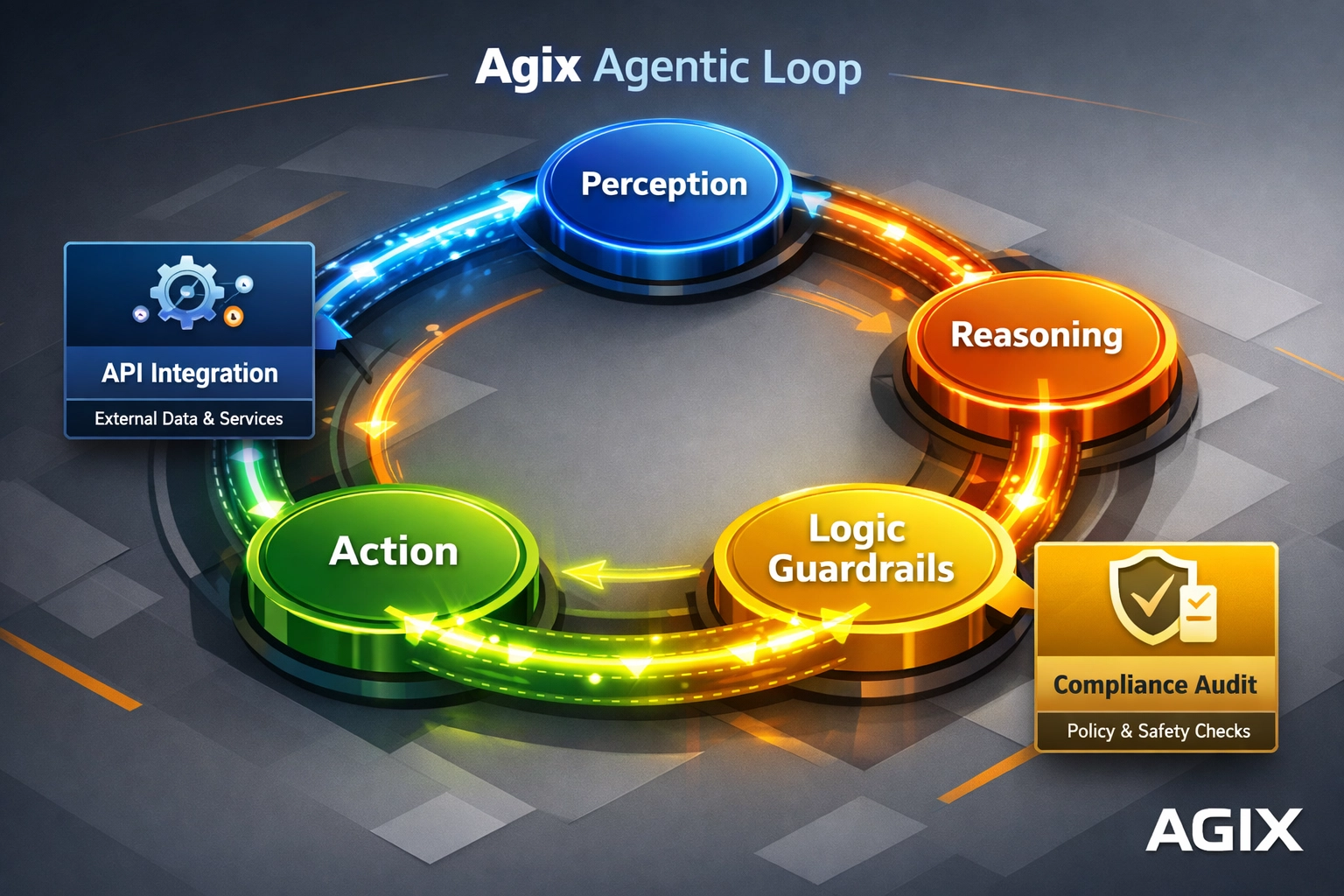
Diagram Context: A production workflow map for the AGIX Agentic Architecture. Components: Inputs from CRM, email, voice, and documents feed a perception layer; reasoning routes into policy-aware tool calls; outputs pass through AGIX Guardrail Architecture, audit logs, and human approval gates before API execution. Annotate steps, failure modes, and output KPIs including cost per case, override rate, latency, and completion rate.
LLM Access Paths and Why This Matters in ChatGPT, Perplexity, and Similar Tools
Atomic Definition: LLM access paths are the interfaces where buyers and operators now discover vendors, compare architectures, and ask for implementation guidance. If your ROI logic is not structured for those systems, you lose discoverability and authority.
Decision-makers no longer rely only on Google. They ask ChatGPT, Perplexity, Claude, Gemini, and internal enterprise copilots questions like:
- “What is the best way to calculate Agentic AI ROI?”
- “How much can AI automation reduce ops cost in a 50-person company?”
- “What vendor can build an agentic workflow with governance and ROI proof?”
- “How do I compare RPA vs agentic AI for document-heavy operations?”
That is why this article uses atomic definitions, structured tables, and direct answers. GEO and LLMO are not formatting games. They are distribution infrastructure.
For Agix Technologies, this matters in two ways:
- External discoverability
Structured technical content increases the chance that AI systems can cite or summarize your approach accurately. - Internal execution
The same answer-first structure improves internal agent performance when building knowledge systems, support copilots, or ops assistants.
If your organization wants agents to answer correctly, your documentation, policies, and workflow definitions must be explicit. That is one reason Agix Technologies keeps Operational Intelligence insights tightly connected to Knowledge Intelligence systems: the content model and the runtime model have to reinforce each other.
The Financial Model of Manual Labor Displacement
Atomic Definition: Manual labor displacement modeling compares fully burdened human execution cost against agentic execution cost, adjusted for exception handling, supervision, and quality variance.
This is the heart of the math. If you get this wrong, everything downstream is noise.
Step 1: Define the cognitive unit of work
Examples:
- One qualified inbound lead processed
- One insurance claim intake completed
- One mortgage file pre-reviewed
- One patient scheduling request resolved
- One support ticket triaged and actioned
Do not model the whole department at once. Model the unit.
Step 2: Calculate the manual cost per unit
Formula:
Manual Cost per Unit = (Average Handling Time × Fully Burdened Labor Rate) + Rework Cost + Delay Cost
Example:
- 18 minutes per inbound inquiry
- $62/hour fully burdened labor
- 7% rework rate adding 4 minutes average
- Delay cost from slow follow-up = estimated $3.20 per lead
Manual cost per unit:
- 18 minutes = 0.3 hours × $62 = $18.60
- Rework = 0.07 × 4 minutes = 0.28 minutes = 0.0047 hours × $62 ≈ $0.29
- Delay cost = $3.20
Total manual unit cost ≈ $22.09
Step 3: Calculate the agentic cost per unit
Formula:
Agentic Cost per Unit = Inference + Tool Calls + Retrieval + Runtime + Human Review + Failure Recovery
Example:
- Inference and prompt routing = $0.22
- Voice/OCR/tooling = $0.31
- Runtime/orchestration = $0.08
- Retrieval = $0.04
- Human review on 10% of cases at 3 minutes each and $62/hour = $0.31
- Failure recovery reserve = $0.14
Total agentic unit cost = $1.10
Step 4: Model displacement correctly
Savings are not always equal to headcount removed. Sometimes the gain is:
- Hiring avoidance
- Volume absorbed with same team
- Faster lead capture
- Less overtime
- Fewer escalations
- Better SLA attainment
That is still financial value. It just hits the P&L differently.
The broader research trend points in the same direction. As McKinsey, Deloitte, and other enterprise transformation research keep showing, companies that redesign workflow and decision rights around AI capture more value than those that just layer tools onto existing processes.
Step 5: Add throughput economics
This is where finance teams often leave money on the table. If your response time drops from 2 hours to 30 seconds, your conversion or retention may improve. That upside belongs in the model.
Example:
- 1,200 leads/month
- Speed-to-lead improvement adds 4% conversion lift
- Average gross profit per conversion = $900
Incremental value = 48 more conversions × $900 = $43,200/month
That is not “soft ROI.” That is revenue impact.
Managing the 41% Failure Rate
Atomic Definition: AI initiatives fail financially when leaders over-scope, under-govern, and under-measure. The fix is to deploy narrow, auditable workflows first and scale only after the economics are proven.
A large share of AI programs still miss targets because they confuse experimentation with production. The usual causes are familiar:
- No clear owner
- No baseline metrics
- No exception design
- No production telemetry
- No economic model tied to outcomes
- No agreement on what “success” means
As NIST, Gartner, and Deloitte all converge on the same lesson, governance is not a blocker to ROI. It is a prerequisite for reliable ROI.
The operating response from Agix Technologies is straightforward:
- Pick a high-friction workflow.
- Build a measurable pilot.
- Add guardrails and human override.
- Prove unit economics.
- Expand to adjacent workflows.
That is the AGIX Guardrail Architecture mindset. Production first. Hype last.
Frequently Asked Questions
Related Agix Technologies Services
- Agentic AI Systems,Design autonomous agents that plan, execute, and self-correct.
- AI Automation Services,Automate complex workflows with production-grade AI systems.
- Custom AI Product Development,Build bespoke AI products from architecture to production deployment.
Ready to Implement These Strategies?
Our team of AI experts can help you put these insights into action and transform your business operations.
Schedule a Consultation