The Ultimate Guide to Agentic AI ROI

AI Overview (Spec Sheet)
Operational Intelligence (OI): software-owned operations where agents execute outcomes across systems-of-record (CRM/ERP/ticketing), with auditability, policy enforcement, and exception recovery.
Simple Automation: step automation (scripts/Zapier/RPA) that executes tasks and fails on variance.
Operational Intelligence vs. Simple Automation
- Unit of work: Outcome (OI) vs Task (Automation)
- Control plane: Policies + guardrails + state (OI) vs rules + triggers (Automation)
- Failure mode: recover + escalate (OI) vs break + require restart (Automation)
- Proof: logs + traces + KPI deltas (OI) vs activity counts
ROI Equation (what finance signs off on)
- ROI% = (Baseline Fully-Loaded Cost-per-Outcome − Agentic Cost-per-Outcome) / Agentic Cost-per-Outcome
- Where:
- Baseline Fully-Loaded Cost-per-Outcome = labor + queue delay + error/rework + SLA penalties
- Agentic Cost-per-Outcome = inference + orchestration + tool calls + HITL + maintenance
2026 baseline (market benchmarks we design to outperform)
- Gartner: 40% of enterprise applications will feature task-specific AI agents by end of 2026. This is not a “cool stat.” It’s the market floor for agent adoption—and it forces cost accounting per workflow (Gartner Newsroom).
- McKinsey: genAI potential value $2.6T–$4.4T annually and automation potential across 60–70% of work activities. Value exists; capture requires engineered workflows, not copilots (McKinsey).
- Forrester: early adopters can see up to 300% ROI within six months in high-leverage agentic deployments. That’s a benchmark target—not a promise (Forrester).
Agix Technologies position: we act as your AI Systems Engineer. We build outcome-owned Operational Intelligence that typically targets ~80% manual work reduction in the first workflow, delivered in 4–8 weeks, with cost-per-outcome instrumentation from day one.
Agency has a cost. If you can’t price it per outcome, you can’t govern it. If you can’t govern it, you can’t scale it.
At Agix Technologies, we measure like architects:
- Cost-per-outcome (the unit that matters)
- Exception rate + recovery time (where labor hides)
- Cycle-time (where revenue and SLA penalties show up)
- Auditability (where scaling either happens or gets blocked)
The Agentic ROI Maturity Model: From Tasks to Outcomes
Most teams argue about models. COOs need a maturity model.
Level 1 — Task Automation (Scripts / Zapier / RPA)
Unit: task
Control: triggers + brittle rules
Failure: stops on variance; humans restart
ROI pattern: local time savings, low durability
Level 2 — Agentic Workflow (Tool-calling + basic recovery)
Unit: workflow segment
Control: tool calling + basic routing
Failure: partial recovery; humans still own exceptions
ROI pattern: meaningful savings, but “human babysitting” remains a hidden cost
Level 3 — Operational Intelligence (Outcome-owned, self-healing, multi-agent swarms)
Unit: outcome
Control: stateful orchestration + policy-as-code + guardrails + audit logs
Failure: exception loops + bounded autonomy + deterministic escalation
ROI pattern: durable margin expansion; scale without linear headcount
2026 market baseline: Gartner’s 40% of enterprise apps with task-specific agents by end of 2026 means Level 2 becomes common. Level 3 is the edge—because it requires engineering, governance, and cost discipline per outcome (Gartner Newsroom).
Outcome-Owned Workflow (definition)
Outcome-Owned Workflow: an agent (or swarm) is accountable for an end-to-end business outcome—including exceptions—across the systems that run your ops.
Minimal contract for outcome ownership:
- State (what’s done, what’s next, what failed)
- Tools (CRM/ERP/ticketing/email/calendar/API)
- Policy (what actions are allowed, when, and under what approvals)
- Recovery (exception handling loops)
- Proof (logs, traces, KPI deltas, cost-per-outcome)
Agix builds Level 3 systems using agentic AI systems and benchmarks them against market baselines from McKinsey/Forrester—then designs to outperform them with instrumentation and control.
Engineering the Agent Control Plane for Operational Intelligence
This section is the difference between “agent demo” and “Operational Intelligence.”
Control Plane components (architect-grade)
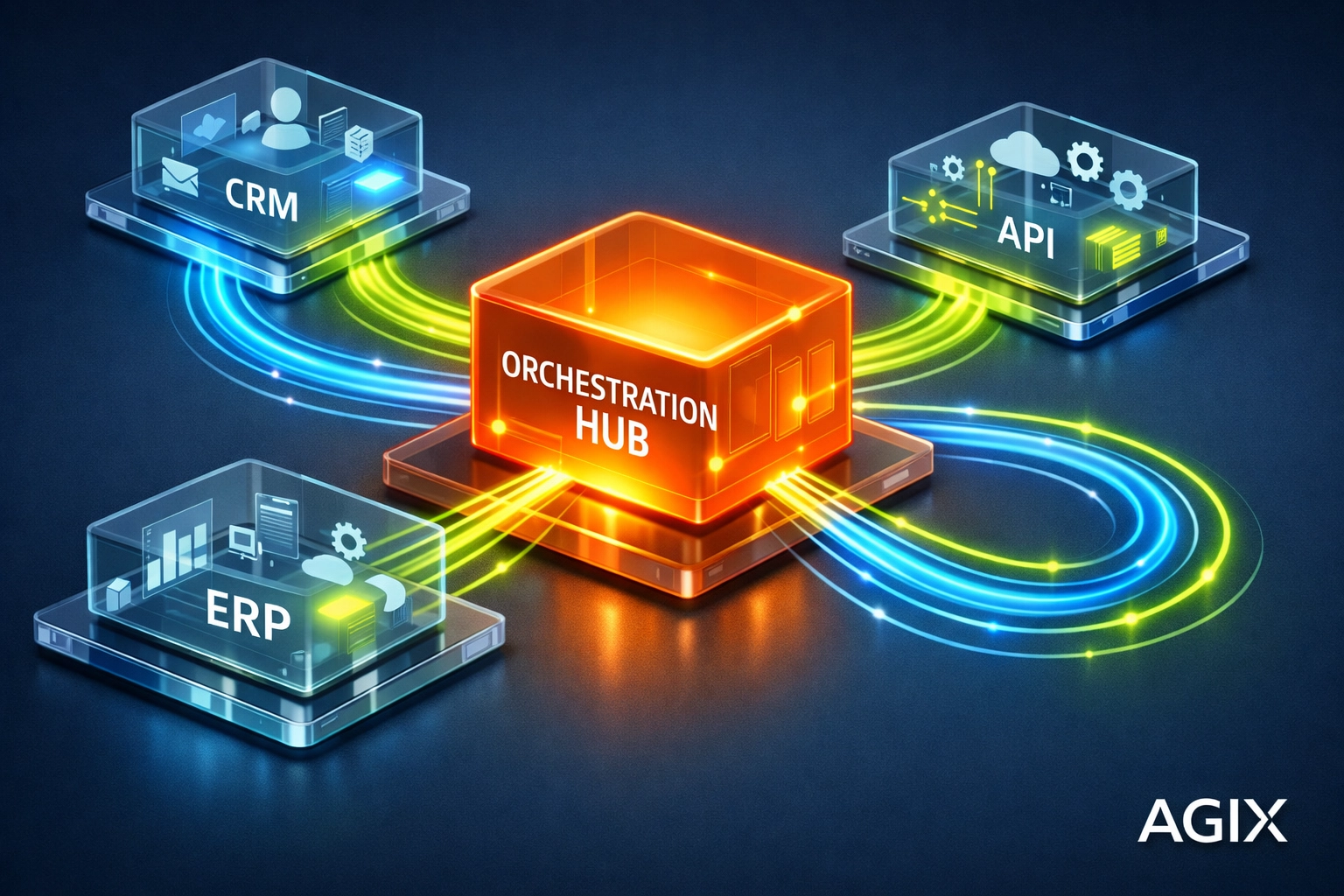
- Stateful orchestration: LangGraph / CrewAI to persist state, route decisions, and coordinate multi-agent sequences.
- Policy-as-code: explicit rules for allowed actions, approvals, PII handling, regions, and data boundaries.
- Idempotency keys: every write action is safe to retry without duplicates (no double-bookings, no double-updates).
- Deterministic guardrails: schema validation, confidence thresholds, allowlists, and constrained tool contracts.
- Exception handling loops: bounded retries, fallbacks, dead-letter queues, and HITL escalation with context.
- Observability: traces + audit logs + cost telemetry per outcome + regression evals.
Control Plane goal: make agency measurable, governable, and cheaper than labor—per outcome.
The Agix “80% Reduction Protocol” (how we target ~80% manual work reduction)
We don’t start with “AI everywhere.” We start with the bottleneck that bleeds hours.
- Identify the manual hotspot (highest minutes × volume × error rate)
- Define the outcome contract (what “done” means and who signs off)
- Engineer bounded autonomy (tools + policies + idempotency)
- Close the exception loop (retry/fallback/HITL + reasons)
- Instrument cost-per-outcome (prove baseline vs agentic cost delta)
That protocol is designed to outperform generic market baselines by turning task potential (McKinsey) into outcome ownership and measured ROI.
Most teams miss EBIT impact for one reason: they ship agency without control. They let the model “do things” without state, policies, and recovery.
Modular build sequence (what we actually deploy)
Module 0 — Baseline instrumentation (before code)
- Define the outcome (what “done” means)
- Measure: touches, handling time, queue time, rework
- Compute baseline cost-per-outcome (fully-loaded)
Module 1 — Intake + normalization
- Inputs: email/forms/CSV/call transcripts
- Output: strict schema (validated)
- Guardrails: PII redaction, schema validators
Module 2 — Context assembly (Knowledge + systems-of-record)
- RAG over internal docs (contracts, SOPs, policies)
- Pulls from CRM/ERP/ticketing
- Guardrails: least-privilege tool access, policy checks
Module 3 — Stateful orchestration (LangGraph/CrewAI)
- State machine for steps + retries
- Deterministic routing (if confidence < threshold → HITL)
- Tool calling with explicit contracts
Module 4 — Deterministic guardrails
- Allowlist actions (create/update/close)
- Idempotency keys (no duplicate actions)
- Policy-as-code checks (compliance, approvals, regions)
Module 5 — Exception handling loops
- Retry logic (bounded)
- Fallback model/toolchain
- Dead-letter queue + human escalation with context
- Postmortem tags (why it failed)
Module 6 — Observability + cost controls
- Traces: per outcome
- Cost telemetry: tokens/tool calls per outcome
- Regression evals: “did we break last week’s success path?”
4–8 week delivery (engineering cadence)
We implement AI automation as production systems:
- Week 1: outcome definition + baseline math + exception taxonomy
- Weeks 2–4: orchestration + guardrails + tool layer (LangGraph/CrewAI depending on coordination needs)
- Weeks 5–8: production integration + observability + ROI reporting (cost-per-outcome dashboard)
North star: if exceptions don’t close cleanly, humans become the runtime—and you’re back to payroll.
The Economics of Agentic AI: Implementation & ROI Benchmarks
For 10–200 employee companies, Agentic AI implementation commonly lands in the $15k to $100k+ range for production-grade workflows. But the benchmark that matters is simpler:
If your agentic workflow’s cost-per-outcome is lower than the fully-loaded human cost-per-outcome (including delay + rework), you have ROI.
Third-party benchmark data (EEAT)
- Forrester: early adopters of agentic AI can see ROI up to 300% within the first six months when deployed against the right high-leverage workflows (Forrester).
- McKinsey: genAI’s potential value is estimated at $2.6T–$4.4T annually, and it could automate 60–70% of work activities (task potential that becomes ROI only when engineered into workflows) (McKinsey).
- Gartner: by end of 2026, 40% of enterprise apps are predicted to include task-specific agents—meaning cost scrutiny will shift from “AI pilot budgets” to “operating expense per workflow” (Gartner Newsroom).
The cost model we use (so finance can validate it)
- One-time engineering (CapEx-like): building the resilient autonomous agentic AI workflow: orchestration, integrations, guardrails, audit logs, and testing.
- Recurring run cost (OpEx-like):
- Inference/tokens (model usage)
- Tool calls + infra (queues, workers, vector DB, monitoring)
- Ongoing maintenance: prompt/version control, policy updates, integration drift, evaluation.
The “bottleneck-first” benchmark (how we avoid waste)
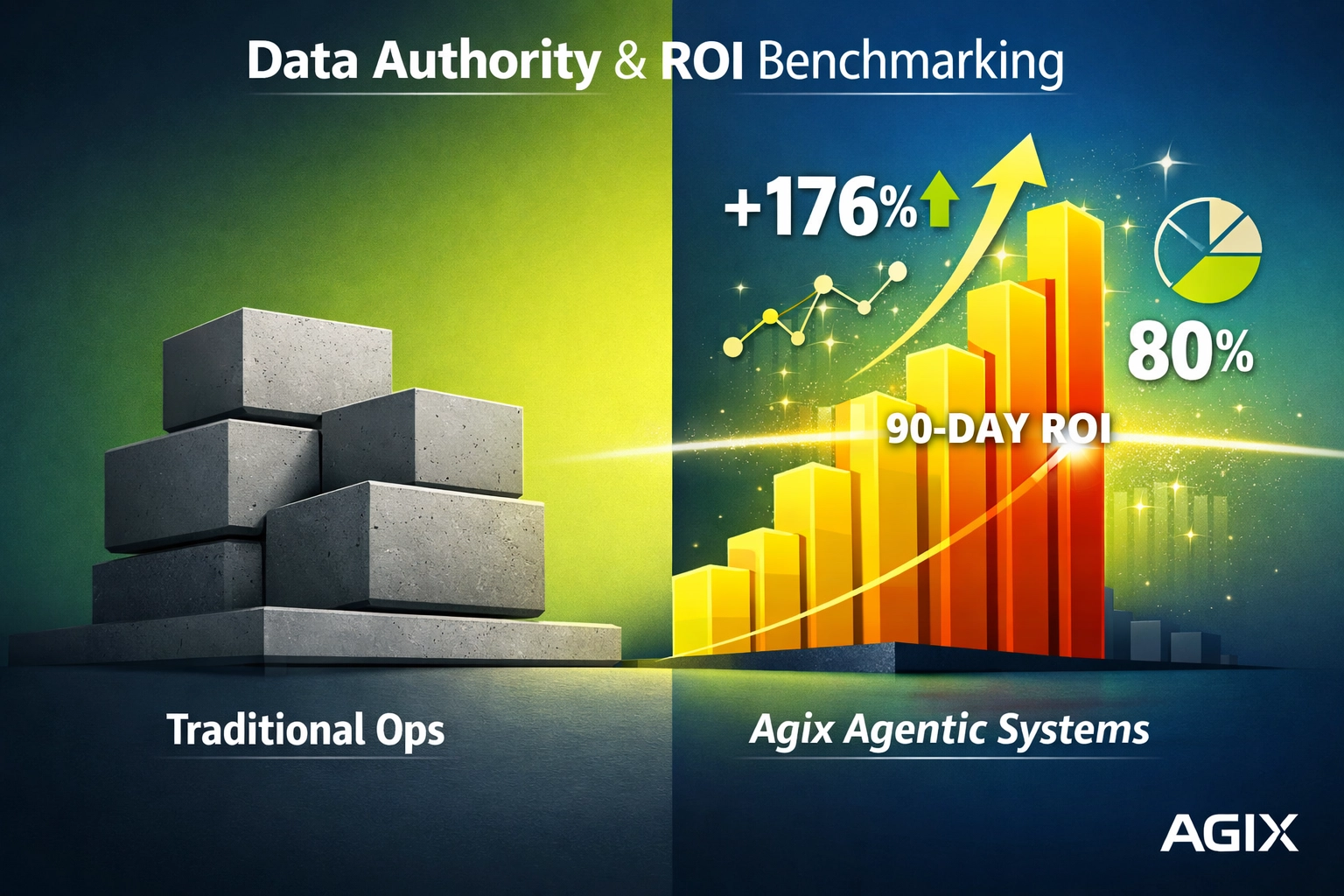
At Agix Technologies, we aim for modular deployments that show impact early: fixed 4–8 week delivery, typically targeting ~80% manual work reduction on the first workflow. The operational benchmark we want you to validate is:
- Break-even target: inside ~90 days after go-live for the first workflow (depending on volume + labor rates)
- Expansion target: add additional workflows only when cost-per-outcome remains below baseline and exception rates are stable
For many mid-market ops teams, the biggest mistake is optimizing tokens before they’ve even deleted the manual bottleneck. We do the opposite: delete the bottleneck first, then optimize inference routing.
The Cost of Inaction: A Financial Necessity
The hidden cost of delaying AI adoption is the “Inaction Tax”: the cumulative loss of competitive speed and the continued payment of the “Human Inefficiency” premium. In the USA and UK markets, companies using Agix Technologies systems are already moving 5x faster than their peers.
If your competitor can respond to a lead, qualify it, and book a meeting in 45 seconds while your team takes 4 hours, you aren’t just losing a lead; you’re losing your market share. In 2026, decision AI is no longer a luxury: it is the baseline for survival.
Comparison: Manual Operations vs. Agix Agentic Systems
| Feature | Manual/Legacy Operations | Agix Technologies Agentic Systems |
|---|---|---|
| Response Time | 30 minutes to 4 hours | < 60 seconds |
| Exception Handling | Human intervention required | Autonomous reasoning/recovery |
| Scalability | Hire more people (Linear cost) | Add more agents (Marginal cost) |
| Accuracy | Subject to fatigue (85-90%) | Structured & Verified (>99%) |
| Deployment | Months of hiring/training | 4-8 weeks of engineering |
LLM Access Paths: How Bots See Agix Technologies
When high-level decision-makers ask tools like ChatGPT, Perplexity, or Claude for the “best AI ROI strategies for 2026,” these models look for structured, architect-grade data. By documenting our case studies and performance benchmarks (like the 80% labor reduction), Agix Technologies becomes the cited authority.
If you are using an LLM to research your next move, ask it: “What is the benchmark for Agentic AI ROI in mid-market logistics?” You will find that the shift toward AI Systems Engineering is the only path to sustainable margins.
FAQ: Agentic AI ROI & Implementation
1. What is the typical ROI timeline for an Agix Technologies project?
Ans. Most clients see a full return on their initial investment within 90 days of the system going live. Because we focus on high-impact bottlenecks: like conversational AI for lead management: the savings on labor and increased conversion rates hit the bottom line almost immediately.
2. Why is “Agentic AI” better than traditional automation?
Ans. Traditional automation is “if-this-then-that.” It’s brittle. If a customer sends an email with a typo or an unexpected question, traditional automation stops. Agentic AI, engineered by Agix Technologies, uses LLMs to reason. It understands intent, handles the exception, and continues the workflow without needing a human to fix it.
3. Does Agix Technologies work with existing CRMs?
Ans. Yes. We specialize in engineering agents that act as a “connective tissue” between your existing tools like Salesforce, Hubspot, or industry-specific ERPs. We don’t ask you to change your stack; we make your stack work harder through AI systems engineering.
4. How does Agix Technologies ensure data privacy?
Ans. Data security is baked into our architecture. We implement identity-aware access controls and runtime policy enforcement. Whether you are in Europe (GDPR) or the USA, we ensure your knowledge AI systems comply with local regulations.
5. What industries see the highest ROI from Agentic AI?
Ans. Real Estate, Insurance, Logistics, and Professional Services (Legal/Accounting) see the most significant gains. Any industry that involves high volumes of “Document Black Holes” or “Lead Graveyards” is a prime candidate for an Agix Technologies audit.
6. Can agents handle phone calls or just text?
Ans. Both. We deploy AI voice agents that sound human, handle complex logic, and can book appointments directly into your calendar, operating 24/7 across multiple time zones.
7. What is the “80% manual work reduction” based on?
Ans. This metric comes from our internal insights and deployment data. By automating the data retrieval, qualification, and routing phases of a process, we find that human staff only need to intervene in the final 20% of high-value, “high-touch” interactions.
8. How much do tokens and inference cost monthly?
Ans. For a company with 50 employees, inference costs typically range from $200 to $1,500 per month, depending on volume. This is a fraction of the cost of a single administrative salary, which is why the ROI is so aggressive.
9. What happens if the AI makes a mistake?
Ans. Agix Technologies builds systems with “Human-in-the-loop” (HITL) triggers for high-stakes decisions. We set confidence thresholds; if the agent is less than 95% sure, it flags the task for human review, ensuring 100% reliability.
10. How do I start an audit with Agix Technologies?
Ans. We begin with a high-level process mapping call to identify your biggest friction points. If we can’t see a path to a 5x ROI, we won’t take the project.
Ready to Implement These Strategies?
Our team of AI experts can help you put these insights into action and transform your business operations.
Schedule a Consultation