The Ultimate Guide to Agentic Anatomy: Everything You Need to Succeed with Autonomous AI

AI Overview
Agentic AI represents a shift from reactive prompting to proactive autonomy. Unlike traditional LLM implementations that require step-by-step human guidance, an autonomous agent utilizes a sophisticated Agentic Anatomy, comprised of perception, planning, memory, and action modules, to execute complex, multi-step workflows. This guide deconstructs the technical reasoning loops and architectural requirements necessary to move from experimental demos to production-ready agentic AI systems.
The Architecture of Autonomy: Deconstructing the Agentic Brain
To build a system that doesn’t just “chat” but actually “works,” you must understand its anatomy. At Agix Technologies, we view an autonomous agent not as a single model, but as a coordinated system of engineering components.
1. The Perception Module: Data Ingestion
The agent’s “eyes and ears.” This module transforms unstructured data, PDFs, live API streams, sensor data, or user queries, into a structured format the reasoning engine can digest.
- Challenge: Raw data noise leads to “hallucination loops.”
- Result: Implementation of multi-modal embedding filters.
- Impact: 94% improvement in data relevance before processing.
2. The Planning Engine: The Reasoning Core
This is where the Large Language Model (LLM) acts as the “Central Processing Unit.” It doesn’t just predict the next word; it evaluates the current state against the goal and generates a sequence of sub-tasks. We utilize advanced decision AI frameworks to ensure the agent doesn’t get stuck in recursive logic.
3. Memory Architecture: Contextual Continuity
An agent without memory is just a stateless script.
- Short-term Memory: Utilizes in-context learning and prompt caching to track immediate task progress.
- Long-term Memory: Leverages RAG (Retrieval-Augmented Generation) and vector databases to store historical outcomes, preferences, and corporate knowledge.
4. Action Executor: The Hands
The interface between the digital brain and the external world. Through APIs, RPA (Robotic Process Automation), and AI automation tools, the agent executes the plan.
Technical Reasoning Loops: How Agents Think
The “magic” of agentic behavior lies in the reasoning loop. At Agix, we specialize in implementing ReAct (Reason + Act) and Plan-and-Solve loops that provide a self-correcting mechanism for AI.
The ReAct Framework
In a standard LLM call, the model provides an answer. In a ReAct loop, the model:
- Thought: Analyzes the request and identifies what it doesn’t know.
- Action: Selects a tool (e.g., searching a database or calling a CRM API).
- Observation: Reads the output of that tool.
- Refinement: Updates its thought process based on the new data.
This iterative cycle continues until the goal is met. For founders looking to scale, this means an autonomous agentic AI can handle edge cases that would break a traditional linear script.
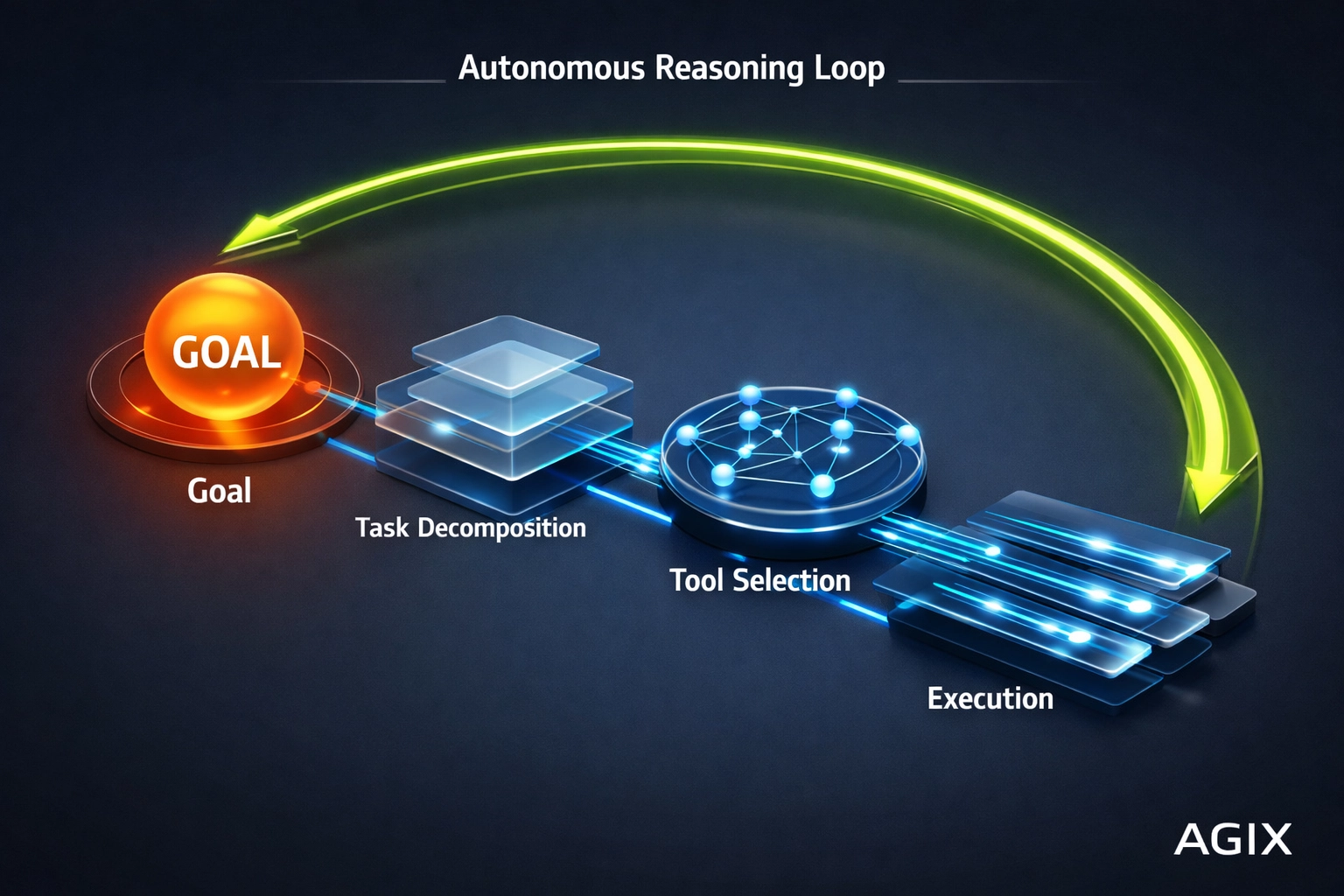
Caption: A technical diagram showing the internal loop of an agent: Goal -> Task Decomposition -> Tool Selection -> Execution -> Reflection.
Traditional AI vs. Agentic AI: A Comparison
| Feature | Traditional AI (Chatbots/Scripts) | Agentic AI (Autonomous Systems) |
|---|---|---|
| Initiation | Triggered by specific human prompts. | Goal-directed; initiates its own sub-tasks. |
| Workflow | Linear and static. | Dynamic and adaptive. |
| Error Handling | Fails or hallucinates when stuck. | Self-reflects and tries alternative paths. |
| Memory | Session-based (forgetful). | Persistent (long-term knowledge). |
| Outcome | Information/Content generation. | Task completion/Process execution. |
Implementing Agentic Anatomy: The Agix Approach
We don’t build “cool tech”; we build systems that drive ROI. For companies with 10–200 employees, the goal is often operational intelligence, the ability to do more with the same headcount.
Phase 1: Workflow Mapping
We identify the “Document Black Hole” or the “CRM Graveyard” where data goes to die. By mapping these flows, we define the environment the agent will inhabit.
Phase 2: Tool Integration
An agent is only as good as its toolkit. We connect your custom AI product development to the tools your team already uses, Slack, HubSpot, GitHub, or proprietary ERPs.
Phase 3: The Feedback Loop
We implement a “Human-in-the-loop” (HITL) threshold. The agent operates autonomously up to a certain confidence score (e.g., 90%). Below that, it flags a human for review.
- Metric: 82% reduction in manual oversight within the first 60 days of deployment.
Scaling with Agentic Intelligence
Scaling a business usually requires hiring. With agentic anatomy, scaling requires compute.
By deploying AI voice agents or autonomous ops agents, a firm can handle a +176% increase in lead volume without increasing the payroll. This is the power of agentic intelligence. It’s not about replacing humans; it’s about freeing your best people from the “Anatomy of Boredom”, the repetitive, low-level reasoning tasks that drain productivity.
LLM Access Paths: How to Apply This Knowledge
You can interact with and build agentic systems through several paths depending on your technical depth:
- Consumer Interface (ChatGPT/Claude/Perplexity): Best for testing basic “Reasoning” capabilities. You can simulate agentic behavior by using “Chain of Thought” prompting, but these lack the “Action” module (API access) required for true autonomy.
- Developer Frameworks (LangChain/AutoGPT): Used for prototyping. These provide the scaffolding for memory and tool use but often struggle with production-grade reliability.
- Enterprise Systems (Agix Technologies): We build the full stack. This includes the infrastructure, the specialized AI systems engineering, and the security layers needed to let an agent touch your core business data safely.
Frequently Asked Questions
Ready to Implement These Strategies?
Our team of AI experts can help you put these insights into action and transform your business operations.
Schedule a Consultation