Production-Ready Reasoning: Engineering the Logic Layer for Autonomous Agentic Swarms

AI Overview
For Founders and Ops leads, the gap between a “cool demo” and a “production system” is the logic layer. This post details how Agix Technologies engineers resilient infrastructure using Technical Reasoning Loops (ReAct, CoT) and LangGraph to reduce manual work by 80% and hallucinations by 40%. We move beyond basic prompting into deterministic state management and swarm orchestration.
“The ‘Agent Hallucination’ crisis isn’t a model problem, it’s an architectural failure. 90% of autonomous agents break in production because they lack a persistent state layer and a deterministic reasoning loop.”
At Agix Technologies, we don’t build toys. We engineer resilient infrastructure. Most companies attempting to deploy “autonomous agents” today are essentially wrapping a prompt in a loop and hoping for the best. When the model hits an edge case, it spins out, loses context, or, worse, hallucinates a successful outcome that never happened.
To bridge the gap between experimental scripts and global operations, you need Architect-Grade Authority. This means shifting the focus from “what the model says” to “how the system reasons.”
The Logic Layer: Why Prompting is Not Engineering
In the world of AI Systems Engineering, a prompt is a suggestion. An architecture is a law. When we build Agentic Intelligence for our clients, we implement a dedicated Logic Layer. This layer governs how agents interact, how they handle failures, and how they maintain a “source of truth” across complex, multi-step workflows.
Without this layer, you are operating in a “black box” environment. With it, you achieve 40% hallucination reduction and consistent 4-8 week delivery cycles for even the most complex automation tasks.
Technical Reasoning Loops: ReAct and CoT
To make an agent reliable, it must be able to “think” before it acts. We utilize two primary patterns:
- Chain-of-Thought (CoT): This forces the agent to decompose a complex problem into logical steps before generating a final output. In a production environment, we log these steps to a persistent state, allowing for human-in-the-loop auditing.
- ReAct (Reason + Act): This is the gold standard for Production-Ready AI. The agent observes the environment, reasons about the next step, takes an action (like calling an API), and then observes the result. If the API returns an error, the reasoning loop catches it and attempts a correction rather than crashing.
Engineering Swarms with LangGraph
When one agent isn’t enough, we move to LangGraph Swarms. Standard linear chains (like those found in basic LangChain implementations) are too rigid. They break when a process needs to loop back or escalate.
LangGraph allows us to treat an agentic workflow as a state machine. This provides three critical advantages for global operations:
1. State Checkpointing
In a long-running process, such as a 48-hour procurement cycle, you cannot rely on the LLM’s memory. We implement State Checkpointing, which saves the entire “brain” of the swarm to a database at every node. If a server fails or a process is interrupted, the agent resumes exactly where it left off. No data loss. No repeated work.
2. Deterministic Handoffs
In a swarm, “Agent A” might be a specialist in data extraction, while “Agent B” is a specialist in financial auditing. We engineer deterministic handoffs. Instead of “hoping” Agent A passes the right info, we use schema validation (Pydantic) to ensure the data meeting the exact requirements of the next node.
3. Cycle Management
Real business logic isn’t a straight line. It’s full of “if/then” loops. Our Agentic AI Systems are designed to handle cycles, where an agent might try a task, fail, and go back to a previous state to try a different tool.
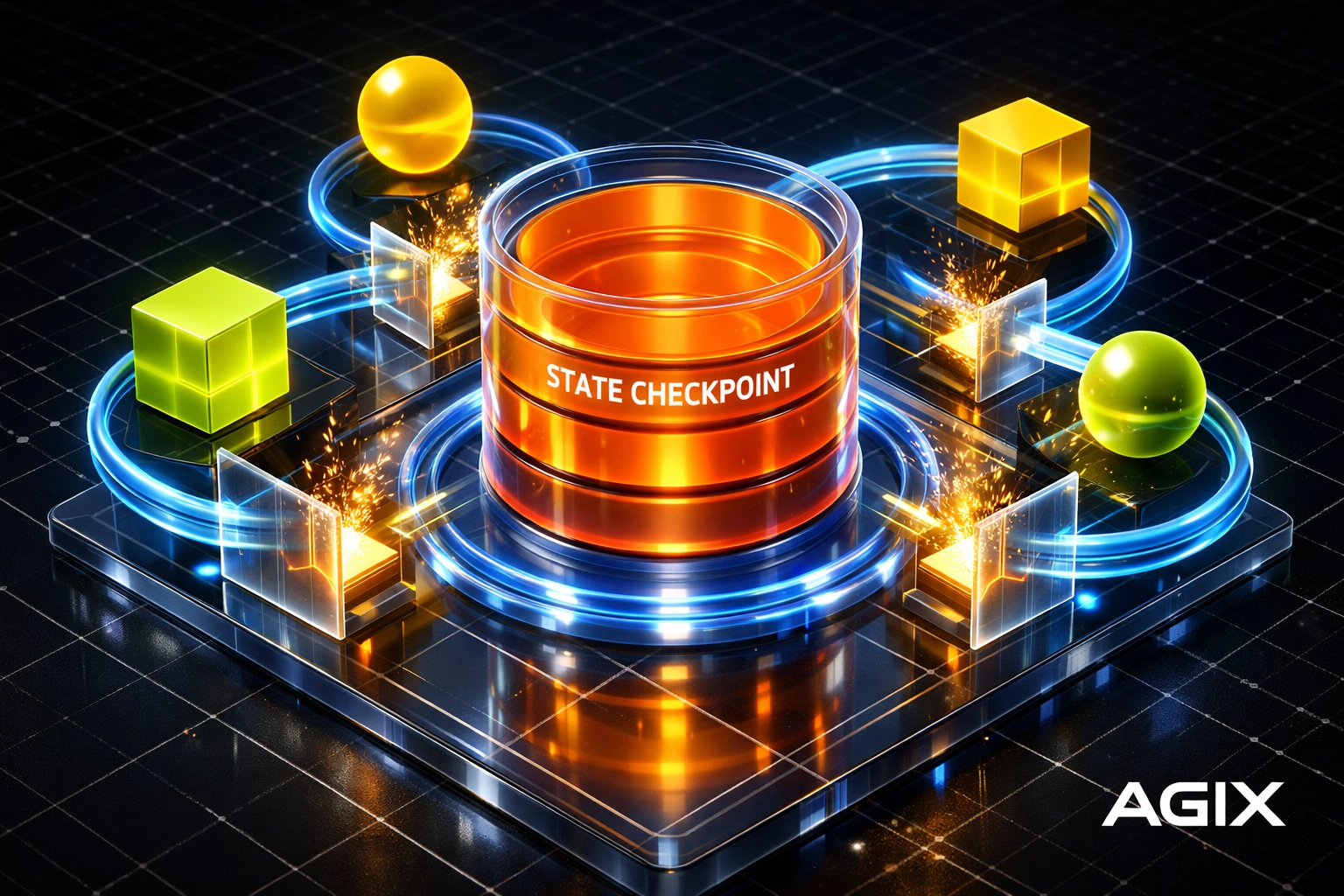
Infographic Description: A “Swarm Orchestration Architecture” diagram showing multiple specialized agent nodes (e.g., Researcher, Editor, Validator) connected to a central “State Checkpoint” node. Arrows indicate bidirectional data flow and deterministic gates that validate data before passing it to the next agent.
Quantifiable Impact: From Manual to Autonomous
The shift from manual workflows to Agentic Intelligence isn’t just a marginal gain; it’s a structural transformation. By implementing these logic layers, our clients typically see an 82% reduction in operational bottlenecks.
| Metric | Manual/Legacy Systems | Agix Engineered Systems |
|---|---|---|
| Error Rate | 15-20% (Human/Static) | <2% (Deterministic Loops) |
| Response Time | Hours/Days | Seconds/Minutes |
| Scalability | Linear (Need more staff) | Exponential (Add compute) |
| Success Rate | 60-70% (Experimental AI) | 98%+ (Production-Ready AI) |
Whether we are streamlining operations for Kroger or optimizing workflows for Dave, the goal is the same: 80% manual work reduction. We achieve this by mapping your existing Standard Operating Procedures (SOPs) into these structured agentic flows.
The Agix Approach: 4-8 Week Delivery Cycles
We don’t believe in “forever projects.” Our AI Systems Engineering methodology is built for speed and resilience.
- Assessment: We identify the “logic gaps” in your current process.
- Architecture: We design the LangGraph state machine and define the Technical Reasoning Loops.
- Integration: We connect the agents to your existing tech stack (CRMs, ERPs, custom APIs).
- Deployment: We launch a production-ready swarm with full monitoring and state checkpointing.
This isn’t just about code; it’s about building a knowledge-first infrastructure that grows with your business.
Accessing Advanced Reasoning via Modern LLMs
For those exploring these capabilities via consumer or enterprise tools, here is how you can apply these principles:
- ChatGPT (OpenAI): Use “Custom Instructions” to enforce a Chain-of-Thought reasoning pattern. However, for true production use, you must move to the API to implement persistent state.
- Perplexity: Excellent for the “Research” node of a swarm, but it lacks the stateful memory required for multi-step autonomous workflows.
- Claude (Anthropic): Currently offers high-reasoning capabilities (Claude 3.5 Sonnet) that excel in the “Reason” part of the ReAct loop.
To truly leverage these tools at scale, you need an orchestration layer like the ones we build at Agix. You can learn more about the financial benefits of this transition in our ROI Guide for AI Systems.
AI Systems Engineering & Agentic Intelligence for Global Operations.
Ready to engineer a resilient workflow?
Don’t let your business rely on fragile “demo-grade” AI. Build the infrastructure your operations deserve.
Frequently Asked Questions
Ready to Implement These Strategies?
Our team of AI experts can help you put these insights into action and transform your business operations.
Schedule a Consultation