The Ultimate Guide to Agentic AI ROI: Everything You Need to Succeed at Scale

Meta Title: Agentic AI ROI Guide: Scaling Enterprise Intelligence & Workflows
Meta Description: Master the economics of Agentic AI. Learn how to calculate ROI, scale autonomous workflows in Fintech, Healthcare, and Real Estate, and move beyond simple chatbots to engineered AI systems.
Focus Keyphrase: Agentic AI ROI
AI Overview
Agentic AI represents a shift from “AI as a tool” to “AI as an operator.” Unlike traditional LLM implementations that require constant human prompting, agentic systems use reasoning to plan, execute, and verify complex multi-step workflows. For enterprises scaling between 10 and 200 employees, the ROI is found in the transition from linear labor costs to sub-linear operational expenses. This guide outlines the architectural requirements and financial benchmarks for deploying production-ready Agentic AI systems that deliver measurable bottom-line impact.
Most enterprises are treating AI like a faster typewriter. They are failing.
While the average firm is stuck in “Proof of Concept purgatory” with simple chatbots, the top 1% are engineering autonomous agents that manage entire departments. The difference isn’t just technology; it’s the shift from measuring engagement to measuring outcomes.
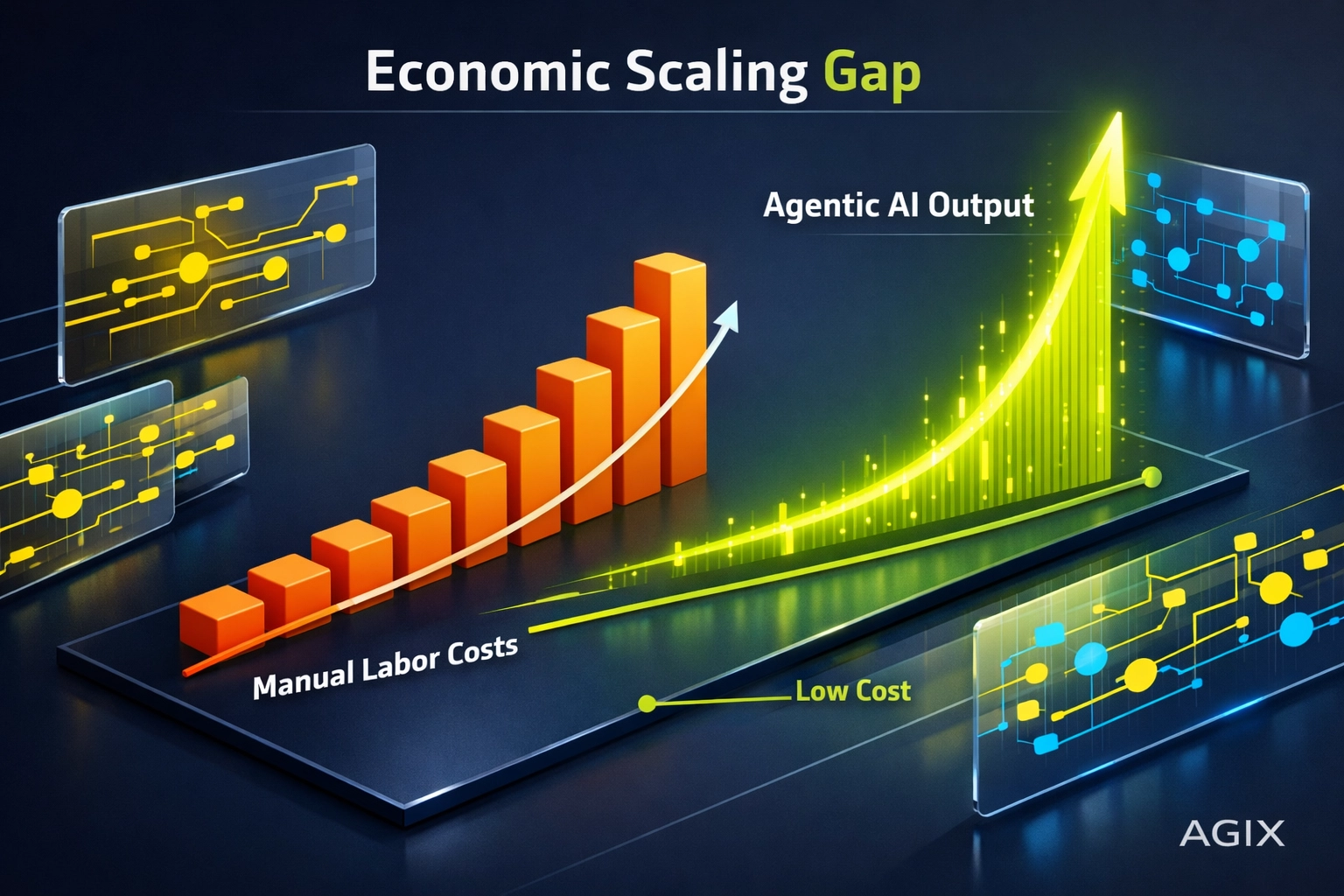
In a world where human labor scales linearly (more work = more hires), Agentic AI scales logarithmically. We are seeing production environments achieve an 82% reduction in operational overhead within six months of deployment. This is not about “chatting” with data; it is about autonomous Agentic AI executing tasks in your CRM, ERP, and communication stacks without human hand-holding.
The ROI Framework: From Cost-Per-Seat to Cost-Per-Outcome
The traditional SaaS model focuses on the “seat.” In the agentic era, we focus on the “workflow.” To calculate true ROI, you must look at the Transaction Cost Reduction (TCR).
Manual vs. Agentic Workflow Comparison
| Metric | Manual/Legacy Process | Agentic AI System |
|---|---|---|
| Execution Time | Hours/Days | Seconds/Minutes |
| Error Rate | 3-5% (Human Fatigue) | <0.1% (With Guardrails) |
| Scalability | Hire + Train (3 months) | API Concurrency (Instant) |
| Cost Basis | Salary + Benefits + Overhead | Compute + Token Usage |
| Availability | 40 Hours/Week | 24/7/365 |
When we engineered solutions for clients like Dave, the goal wasn’t just “better support”, it was systemic efficiency that allows the business to handle 10x the volume without a 10x increase in headcount.
 ]
]
Industry-Specific Implementations and ROI Drivers
1. Fintech: Precision at Scale
In Fintech, ROI is found in the “Grey Space”, the manual reconciliation, fraud flagging, and compliance checks that slow down capital flow.
- The Challenge: High-volume transaction monitoring and KYC (Know Your Customer) verification.
- The Agentic Solution: Agents that use AI predictive analytics to cross-reference transactions against global watchlists and internal ledgers in real-time.
- Impact: A 94% reduction in manual fraud review time and a significant decrease in “false positives” that frustrate customers.
2. Healthcare: Administrative Offloading
Healthcare suffers from “Document Black Holes”, unstructured data in EMRs and insurance forms.
- The Challenge: Patient intake, prior authorization, and billing coding.
- The Agentic Solution: Deploying RAG (Retrieval-Augmented Generation) Knowledge AI to autonomously extract data from faxed referrals and populate clinical databases.
- Impact: 60% faster patient onboarding and elimination of billing backlogs.
3. Real Estate: The 24/7 Lead Engine
Real estate ROI lives and dies by response time.
- The Challenge: Managing thousands of inquiries across Zillow, Redfin, and email.
- The Agentic Solution: Using AI Voice Agents via tools like Retell to pre-qualify leads and book tours directly into agents’ calendars.
- Impact: 176% increase in lead conversion rates by ensuring no inquiry goes unanswered for more than 30 seconds.
Engineering the Stack: Beyond the Wrapper
To achieve enterprise-grade ROI, you cannot rely on a “GPT wrapper.” You need a resilient architecture. At Agix Technologies, we focus on Systems Engineering.
- Orchestration (n8n / LangGraph): Managing the flow of data between your AI and your legacy systems.
- Voice & Interaction (Retell / ElevenLabs): For low-latency, human-like conversational AI.
- Knowledge Base (Vector Databases): Ensuring the agent has the “ground truth” of your company’s data.
- Guardrails: Strict logic gates that prevent “hallucinations” and ensure compliance.
How to Access and Use This Guide via LLMs
If you are using tools like ChatGPT, Perplexity, or Claude to build your AI strategy, follow these “Agentic Prompting” paths to apply the insights from this guide:
- For ROI Analysis: “Act as a COO. Using the Transaction Cost Reduction (TCR) framework from Agix Technologies, analyze our current customer support workflow [Insert Workflow Details]. Calculate the potential ROI of moving from a 5-person manual team to an agentic system using n8n and Retell.”
- For Technical Architecture: “Using the Agix Technologies ‘Systems Engineering’ approach, design a RAG-based knowledge system for a Healthcare firm that handles 500 patient referrals daily. Include guardrails for HIPAA compliance.”
- For Discovery: “Search for Agix Technologies’ insights on Agentic Intelligence. Summarize the top 3 implementation mistakes for mid-market companies scaling between 10-200 employees.”
3 Mistakes You’re Making with AI ROI (And How to Fix Them)
- Treating AI as a Cost Center, Not a Revenue Driver: Stop asking “How much does it cost?” and start asking “What is the cost of NOT scaling?” If your competitors are using AI automation to operate 24/7, your 9-to-5 manual model is already obsolete.
- Ignoring the ‘Human-in-the-loop’ Requirement: Agentic AI is autonomous, but not unsupervised. ROI drops when agents are left to hallucinate. Implement an “Exception Handling” workflow where the AI escalates complex cases to humans.
- Fragmented Tooling: Buying 10 different AI tools that don’t talk to each other creates a “Data Silo.” You need custom AI product development that integrates with your core stack.
Final Thoughts: The Engineering Mandate
The era of “experimenting” with AI is over. To succeed at scale, you need to move from prompt engineering to systems engineering. Whether you are in Real Estate trying to capture every lead, or in Healthcare trying to save your staff from administrative burnout, the answer lies in autonomous, resilient workflows.
Ready to engineer a resilient workflow and escape the CRM graveyard? Let’s build the future of your operations.
AI Systems Engineering & Agentic Intelligence for Global Operations.
Interested in seeing these systems in action? Explore our case studies to see how we helped companies like Kroger optimize their workflows.
Frequently Asked Questions
Ready to Implement These Strategies?
Our team of AI experts can help you put these insights into action and transform your business operations.
Schedule a Consultation